
I recently came across an interesting discussion. Someone mentioned that their company is developing their own CRM system. I thought the times were long gone when a company could afford a completely custom, built-from-the-ground-up CRM system, and that it just didn’t make any sense. But is that the case?
Maybe I’m wrong, and this is something everyone should start doing tomorrow?
Let’s find out together!
In this article, I will:
- Give you context on why custom CRM systems are developed and why, for some companies, that may be a feasible option.
- Dive into arguments supporting the development of a custom CRM system.
- Share my perspective on whether I think it makes sense in 2025 or not.
Ready to explore whether building a custom CRM is the right move in 2025? Let’s dive in!
A Little Context on Custom CRMs
Let me first start with a little bit of context. In the beginning of the digital era, there were only a few products available on the market to support companies with their efforts to engage with their clients. Most of those solutions were closed source, had low customizability, and were on-premise solutions.
On-premise meant that you would purchase a box with CDs, put them in your large corporate server, and install them. Then you would grant access to that software by connecting to the server via a client computer. It sounded a bit complicated. So you had a computer, and you would connect to your company’s server from that computer. No third-party apps. Everything lived inside one organization.
To put it mildly, that approach was not very flexible. Companies had to manually update the software, and every update was always a pain. It would bring a lot of bugs, glitches, and delays in work, and sometimes even result in the loss of data. A lot of companies were not happy with paying for software that would cause more harm than good, so they started to look for alternatives.
Now, put yourself in the shoes of a manager in the late 90s and early 2000s. The IT industry was in its late infancy. You could hire developers in-house relatively inexpensively, and for a little premium, they could outperform any ready-made software on the market. That sounds like a solid strategy, and a lot of companies actually went down that path and built internal development teams.
But technology evolved. The corporate software market was growing very rapidly. In the early 2000s, Salesforce offered a completely new model for purchasing software. Instead of a fixed, one-time payment for software that you would later own and could, theoretically, use for decades, you could now pay a small monthly fee, get going, and rent software from the vendor. No servers, no maintenance, and no complex and painful updates.
In theory, companies that purchased software once could use the product for decades, and that was an argument made by those old-school dinosaurs selling the software. However, in reality, companies needed a more fast-paced solution, and so-called SaaS (Software as a Service) models, where you pay a monthly subscription, slowly replaced on-premise solutions.
But then, the tables started to turn around again. When software companies realized they had taken most of the market, they started to capitalize on their dominant position and began to raise prices. Worse than that, software solutions that offered out-of-the-box functionality still had to be heavily customized to be usable for companies that had already paid for a subscription.
And a lot of companies started to think about going custom and developing their software solutions on their own. Again. But the biggest question remains open: Is it worth it in 2025?
Arguments Supporting a Custom CRM
When I was preparing this article, I was thinking: what are the arguments for a custom CRM? I did a small amount of research and listed the most popular ones:
- You own the system and do not pay a subscription. Fair enough.
- You have greater flexibility. You can go in any direction and build something unique. Also fair. I couldn’t argue with that.
- You have better data privacy. Given you implement the best security practices, this could also be true.
- You own proprietary technology that is your company’s intellectual asset. I wouldn’t agree with that, but it could be important for some investors.
- You are independent from vendors. You will not be left behind if a vendor goes south. True, and I could actually relate to this point. I’ve seen many software companies go bankrupt, leaving their customers with lost data and wasted investments in the platform.
So, what do we have? Creating a custom solution is:
- Seemingly cheaper, as you don’t pay a subscription.
- Owned by you, which makes you very flexible.
- Free from vendor dependency.
That sounds like a solid foundation.
The Feature Scale
I thought it would be hard to beat those logical arguments since I agree with a lot of them, but I needed to build my own opinion on this topic. Intuitively, I felt like creating a custom CRM doesn’t make sense. But every time I sat down to explain why I think it doesn’t make sense, I found myself providing vague arguments that only someone with deep industry knowledge could understand.
I needed something simple. I needed something that my 8-year-old son would understand. So I thought, “It should be a drawing.”
Another two days of procrastination led me to draw a hypothetical scale where I would compare two companies.
Now, imagine a timeline, which we’ll call the feature scale. This scale starts at 0 – representing no CRM at all, not a single line of code. The scale is infinite, as theoretically, you could improve your CRM indefinitely.
I will draw two companies on the same scale and compare them. That way, it will be evident how these two approaches compare.
So, Company A decided to build its own custom CRM, and Company B decided to go with a ready-made CRM from a major vendor that is not likely to disappear in the next ten years. The farther you go on that feature scale, the more robust, feature-rich, and usable the CRM system becomes. By the way, this comparison is not only applicable to CRM. It works with most software nowadays.
Day 1: Starting the Journey
Now, let’s draw a scale.
Company A begins the development process. They create a backlog of user stories (a fancy name for a list of features), then prioritize them and kickstart development from scratch. At this point, they’re at 0 on the feature scale.
Company B signs a contract with Cloud CRM from a major vendor. On Day 1, they already have access to its out-of-the-box features: Accounts, Contacts, Leads, Opportunities, and most importantly, user interface features like list views, record editing screens, and so on.
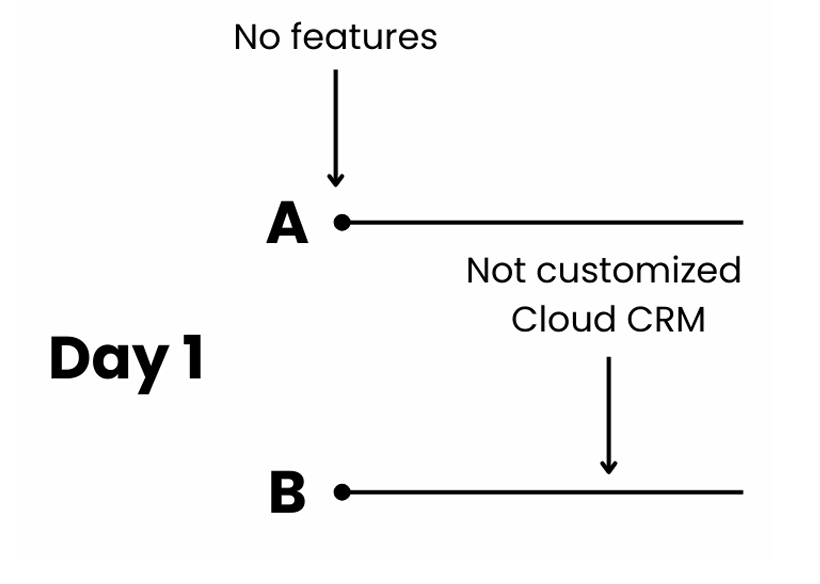
Let’s put both companies on the scale.
On Day 1, Company B has tons of features. All they have to do is study what features the platform has and decide on the priority.
Company A, on the other hand, not only has to decide what features they need but also develop them, manage a team of developers, and ensure that what they are building is sustainable. When I say sustainable, I mean they have to make important technical decisions that will not later create a block preventing them from building more features.
I could compare this to the foundation of a building. If you plan to build a two- or three-story building, you will lay a foundation accordingly. You will not be able to build another ten floors on top later. Surprisingly, this analogy is exactly how software works. If you fail in the planning stage, you will have to rebuild your product from the ground up.
Day 2: The First Steps
Now let’s take a look at the hypothetical Day 2.
Company A assembles a dream team: talented software engineers, quality assurance specialists, and UX experts. They start coding, building their CRM brick by brick. They set up a nice scrum team, hire a product owner, a scrum master, and other people with fancy titles. Let’s assume they do all that.
Company B, on the same day, starts configuring Cloud CRM. Instead of coding, they customize workflows, fields, and dashboards using Cloud CRM’s click-and-configure tools.
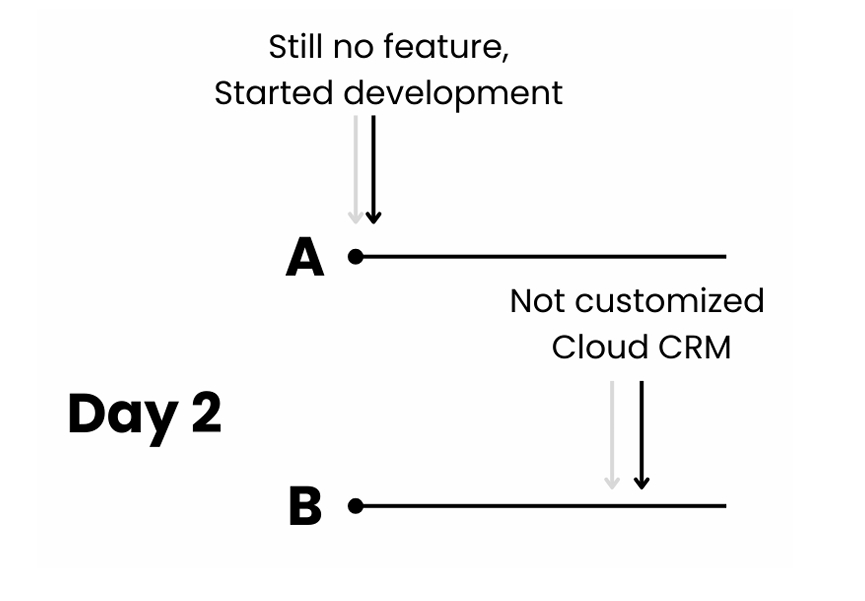
Now let’s look at both companies on the scale. While Company A has set up its team and kicked off the project, Company B already has an out-of-the-box platform. On Day 2, they can start monetizing it by tracking their leads and implementing small processes to get familiar with the platform.
Day 100: Measuring Progress
Now let’s fast forward to the theoretical Day 100.
Company A releases its first beta version. They roll it out to a small group of, say, 10 users for testing. They still have to develop the user interface, reporting tools, API interfaces, and many other features. But they can start testing.
Company B has been using Cloud CRM for months. Their sales team is actively managing leads, closing opportunities, and generating insightful reports. Meanwhile, they decide to implement a self-service portal for customers, where they can access their invoices and technical documentation for whatever product they are selling. To their surprise, Cloud CRM already offers a tool for building custom portals using clicks and minimal custom code, enabling faster deployment.
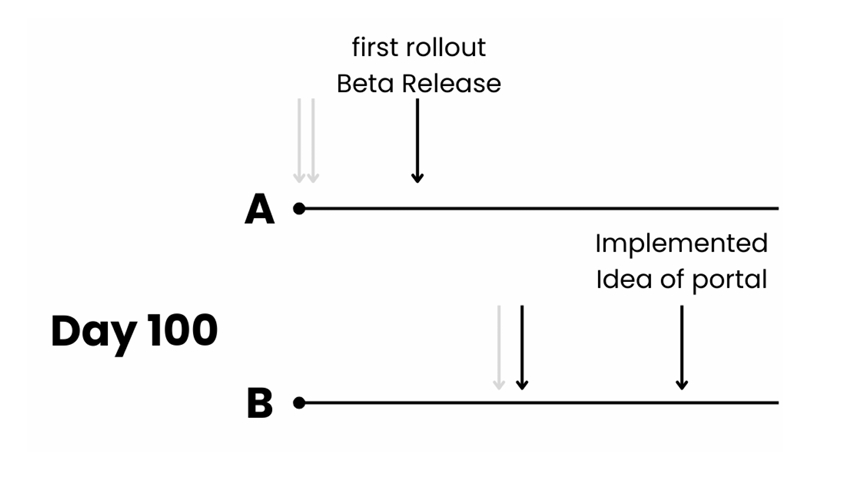
If we take a look at the feature scale, Company B has moved far beyond Company A. Why? Because they don’t have to build the foundation. They can leverage the existing foundation of Cloud CRM. By “foundation,” I mean seemingly simple things like reports, record screens, and business processes that are configurable with clicks, not code, in Cloud CRM.
Remember, if you’re building a custom solution, you will have to build everything – user management, user interfaces, security settings, API connectors. Even a data export feature will have to be built. If you want to build email integration, you will have to build it from scratch, test it, debug it, and do all that without external support. That will require resources. Something you can configure in Cloud CRM in days, maybe weeks, will take you months and possibly years with your custom product.
We could continue that scale, and Company A will be losing every time. The farther we go, the bigger the gap will become.
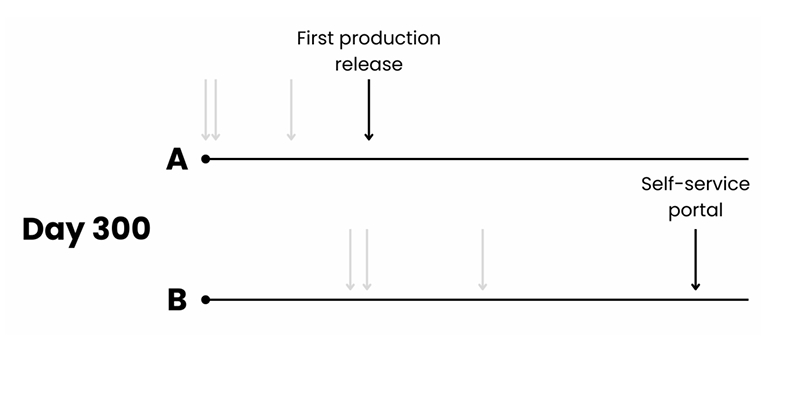
But that’s not the worst part. Remember I mentioned the importance of the foundation? As time goes on, Company A will inevitably accumulate so-called technical debt.
Technical debt can be compared to our health. If we don’t care about our bodies, we accumulate strain and health issues. At some point, we lose the ability to perform, and it costs us twice as much to compensate. Sometimes, it’s even impossible to compensate.
Now let’s circle back to Company B, which is using a third-party product used by millions of other companies. Cloud CRM products have huge teams behind them doing what Company A is trying to do on their own. The only difference is that Cloud CRM has the resources to attract the best developers in the world since they all want to work on something that makes a bigger impact.
Now let me ask you something. Who would you rather be?
Company A, with a custom-built CRM still in its early stages, requiring ongoing development and iterations? A company that is not a dedicated CRM company, trying to build its own proprietary product and wasting resources that could be used elsewhere, like in marketing, sales, and refining their core product?
Or Company B, leveraging a ready-made Cloud CRM, already operating efficiently and rapidly scaling with advanced tools?
I should admit that even Company B will inevitably make errors and take wrong paths that cost them time and money. But the cost of their mistakes will be much smaller since Cloud CRM will have some limitations that prevent the company from ruining it with wrongdoing.
Final Thoughts
I understand that for a lot of managers, developing a custom solution seems like a better choice. It seems like they will spend less money and time, but in reality, it’s just the opposite.
I also understand that if a company decides to build its own solution at the beginning of the digital era, it’s tough to challenge the status quo inside the organization and decide to abandon something that was developed for years, with thousands, if not millions, invested.
But that’s my opinion on the reality in 2025. And what’s your view on the future of CRM? Stick with custom builds or rely on proven cloud solutions?
If you’re currently weighing this decision for your business, we’d be glad to help. Together, we can review all the pros and cons specific to your business and find the right solution based on your unique needs. Reach out to us at Muncly, and we’ll help you navigate the most suitable path forward!