
I believe many of you share the memory of that heavy, cast-iron frame with the famous Singer logo. I always thought it was some sort of grandfather’s trophy from the Second World War era. Singer sounds and feels to me like a reputable German company from the beginning of the last century. Except it’s not German, and it’s not from the beginning of the last century, but rather from the middle of the century before, which predates electricity.
But did you know that, thanks to Singer, we have the world as we see it today? The company contributed to the modern leasing financing model, pioneered the so-called Patent Pools, led the way in modern chains of stores, and so much more. It implemented so many management innovations that it’s hard to find a single book on management today that wouldn’t contain foundations that were laid by the Singer company.
But what I find even more interesting about Singer, is the fact that it was founded by people who couldn’t stand each other. It’s a story, how friends betray each other when they are most vulnerable. It’s a story that taught me that success is not always a result of hard work, but often is a result of good presentation skills.
When preparing this material, I realized that telling only the story of the company turned into a massive list of inventions, which deserves a separate article. Yet, I found the life of one of the company founders so contradicting to what the company did, that I’ve decided to split this story into two parts. This is the part about Isaac Merritt Singer.
For me, the sewing business is a deeply personal story. I was born and raised in the family of entrepreneurs who founded and ran a sewing factory and owned several clothing brands. So when I stumbled upon Singer as a potential topic for my research, I didn’t think twice. I wanted to know more.If this world fascinates you as much as it does me, you’re in for a story that’s far more dramatic than a simple invention tale. So keep reading!
The Flamboyant Founder
Isaac Merritt Singer gave the company its name. His real dream was the stage. He wanted to be a Shakespearean actor and spend his life performing, but he never managed to make that career work. For decades he drifted, chasing money, fixing and modifying machines on the side, searching for something that would finally hit. The breakthrough came in the 1850s with a sewing machine design that actually worked – a success made possible mostly by a business partner he couldn’t stand. Singer’s life fits the old line: he had no enemies, but even his friends didn’t like him. To understand Mr. Singer, we have to circle back to his origins.

Isaac Singer was born in 1811 in Pittstown, New York, the youngest child of Adam and Ruth Singer. His father, a German immigrant with Jewish roots, and his mother, raised in the Quaker tradition, separated when Isaac was about ten.
Quakers are members of a Christian movement that emerged in seventeenth-century England. They reject formal clergy, emphasize inner personal faith, and follow strict principles of simplicity, honesty, pacifism, and equality. Their communities are known for plain living, silent worship, and strong involvement in social reform.
Living in Oswego at the time, Isaac Singer watched his mother leave the family permanently, an experience that likely shaped his attitude toward women later in life. By twelve, conflict with his stepmother pushed him to run away to Rochester, then a fast-growing Erie Canal town. He spent the next seven years there, working in a mechanic’s shop. At eighteen he was already proud enough of his abilities to claim he picked up the trade in just a few months while studying during the winters.
Mechanical work did not satisfy him. Theater pulled him in, even though many people disapproved of theaters, seeing them as something of low morale, with some towns even banning them. In 1830, at eighteen, he joined a traveling troupe and started a restless life on the road. People who saw him then described a tall, blond, charismatic young man who enjoyed playing King Richard. Money was scarce; he survived by taking any temporary work he could secure.
Isaac’s personal life followed a pattern of concealment, impulse, and constant motion. In 1830 he married fifteen-year-old Catherine Haley. They had two children and remained legally tied for the next thirty years. The marriage existed mostly on paper because he kept leaving home, chasing theater work and odd mechanical jobs. Local newspapers criticized what they called his inappropriate closeness with women wherever he traveled. That criticism was accurate.
In Baltimore he met Mary Ann Sponsler. He didn’t tell her the fact that he already had a wife. He courted Mary Ann, convinced her family he was free to marry, and got engaged. They moved to New York and began a family. Their first child was born in 1837. Nine more followed, though they lost two at birth. Singer introduced Mary Ann to everyone as Mrs. Singer, and the city accepted that name without hesitation and background checks. People believed she was his lawful partner. She never was.
This pattern repeated. While maintaining his household with Mary Ann, he built others. By the late 1850s he kept four separate homes operating at once across Manhattan. Each woman believed she was in a committed relationship with him. Each household had children. By 1860 he had sixteen surviving children with four different women. Later, after leaving the United States, he added six more with Isabella Boyer in England, the woman he finally made his legal wife.
This brings us to Isaac’s professional life.
Professional Life
Isaac kept chasing inventions, hoping one of them would turn into real money. In 1839 he built a rock drill and sold the patent for two thousand dollars. The money disappeared almost immediately. Next he designed a carving machine for a wooden type.
The wooden type was big printing letters made out of wood. Printers used them for posters and headlines because metal letters that size were too heavy and too expensive. Craftsmen normally carved each letter by hand, which was slow, fussy work.

Singer’s “carving machine for wooden type” was his attempt to automate that job. Instead of a craftsman cutting every curve and angle, the machine would shape the letters faster and more consistently. It was one of his many attempts to find a shortcut to wealth, long before he ever touched a sewing machine.
However, nothing he did turned into lasting income. By 1849, at thirty-seven, he was back in New York trying again, long past the age when most men with real prospects had already secured them.
The same year, Isaac was looking for investments to continue his work on his carving machine. He met George Zieber, a Philadelphia publisher, who loaned him seventeen hundred dollars to keep the carving machine project alive. That push for cash and a workable idea sent him to Orson Phelps’ machine shop in Boston, where the sewing machine that finally changed his life would take shape.
Invention: The Practical Machine
Along with relocating himself, he brought his family to Boston and kept working on his carving machine, just as the market for such tools collapsed because a wooden type was being replaced by metal. In the same period, Phelps’ workshop had started producing sewing machines. The basic idea had emerged in Europe, but early adoption stalled because sewing guilds fought to protect their trades. Several inventors in America pushed the technology forward, yet none had produced a machine that was dependable or commercially viable.
Singer’s business partners pushed him to study the models coming out of Phelps’ shop and see whether he could improve them. His first reaction was contempt. He viewed sewing devices as a minor trade, beneath his skills. He also repeated the common belief of the time that sewing machines would leave women with nothing to keep them occupied. He mocked the device and dismissed the task. But he needed money. His view was direct: The invention did not interest him. Income did. So he finally turned his attention to the sewing machine.
Zieber and Phelps deserve a proper introduction, because the early Singer story wasn’t a one-man act. Edward Zieber was the rare investor willing to stake money on Isaac’s chaotic talent. He wasn’t a machinist or inventor; he was the steady, practical partner who kept the venture funded, managed the paperwork, and pushed Singer to stay focused long enough to turn rough ideas into real products. Orson Phelps, on the other hand, owned the machine shop where all experimentation happened. He supplied the workspace, the tools, and the technical discipline that Singer – whose strengths leaned toward improvisation rather than method – badly needed.
Together, Zieber’s capital and pressure, and Phelps’s workshop and mechanical know-how, formed the structure around Isaac’s creativity. And in 1850, Zieber, Singer, and Phelps entered into a three-way business arrangement, which was never formalized. This later left Phelps with no stake in the company.
Working almost without pause, Singer and Zieber produced a machine that actually functioned well: stable, durable, and thoughtfully built. It introduced several decisive improvements, including a more practical layout and a redesigned needle that solved many earlier flaws.
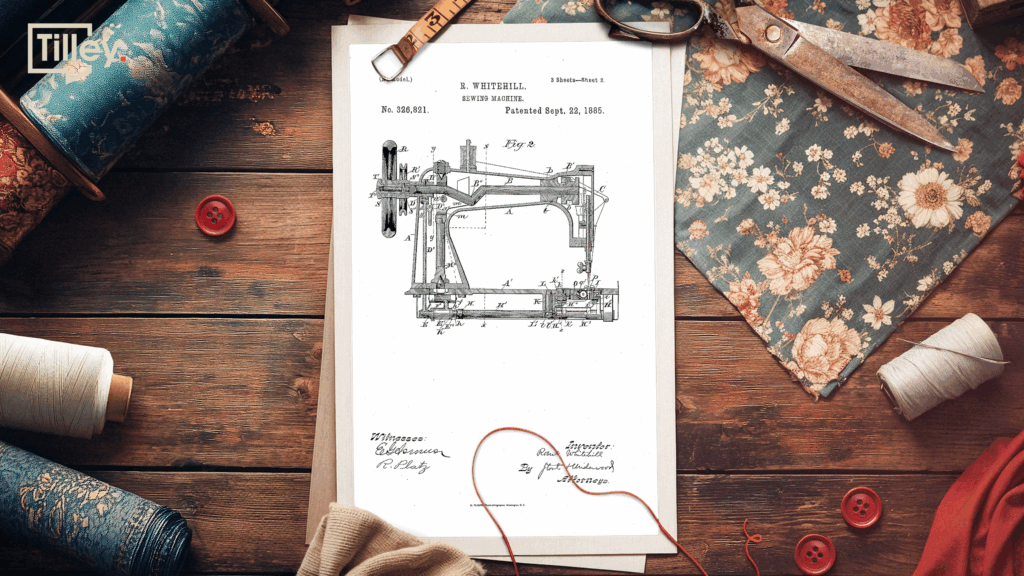
By 1851 the machines reached the market, aimed first at garment manufacturers and wealthy households. Singer’s loud, theatrical nature still carried traces of his old stage ambitions. He turned every demonstration into a performance. He shouted “The Song of the Shirt” and promoted the machine with the energy of a showman.
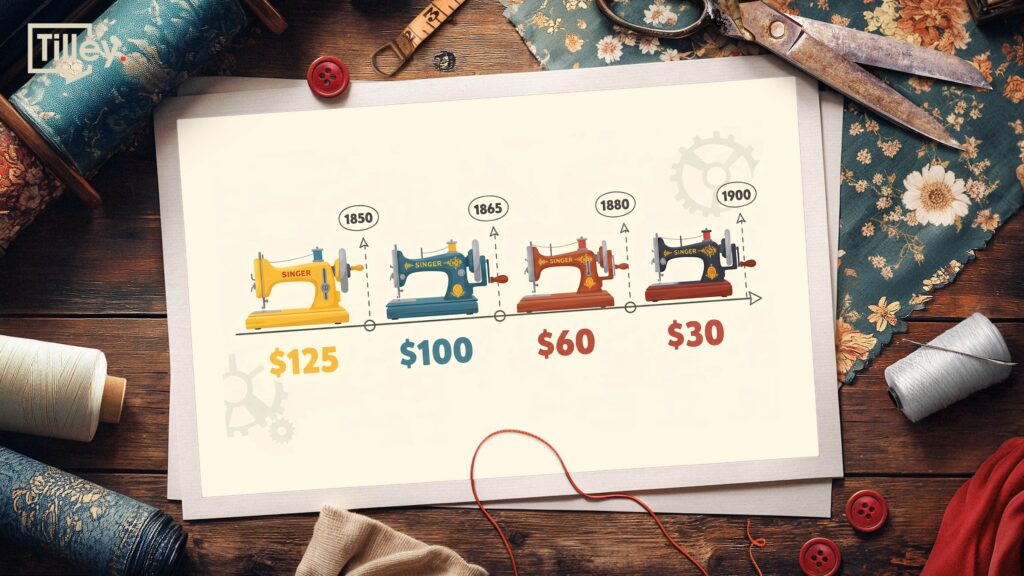
The productivity leap was extraordinary. A men’s shirt that once required fourteen and a half hours of hand labor could now be completed in just over an hour. Historians often rank the sewing machine among the most consequential inventions of the nineteenth century. However, with a price tag of $125, which is roughly $4,000 US dollars in today’s money, early sales moved slowly.
But slow sales were only part of the problem. The moment Singer’s machine reached the market, the company collided with a far more corrosive threat: endless litigation. Dozens of inventors claimed they had created essential parts of the sewing machine long before Singer, and every one of them wanted payment. Patent disputes piled up faster than customers. Court orders blocked production, competitors filed injunctions, and the company spent more time fighting in legal offices than selling in factories.
The early sewing-machine industry wasn’t a race to innovate. It was a knife fight over who owned the right to sew a straight line. Without resolving that conflict, no amount of engineering brilliance or showmanship could save the business.
The Company: A Partnership of Bitterness
Discouraged by the slow pace of early sales and patent wars, Singer tried to sell off his stake for $1,500. Edward Zieber stopped him, insisting the venture still had a future. At that exact turning point, a new figure entered the story: Edward Clark, a lawyer just two months younger than Singer, who stepped in to manage the escalating patent battles.
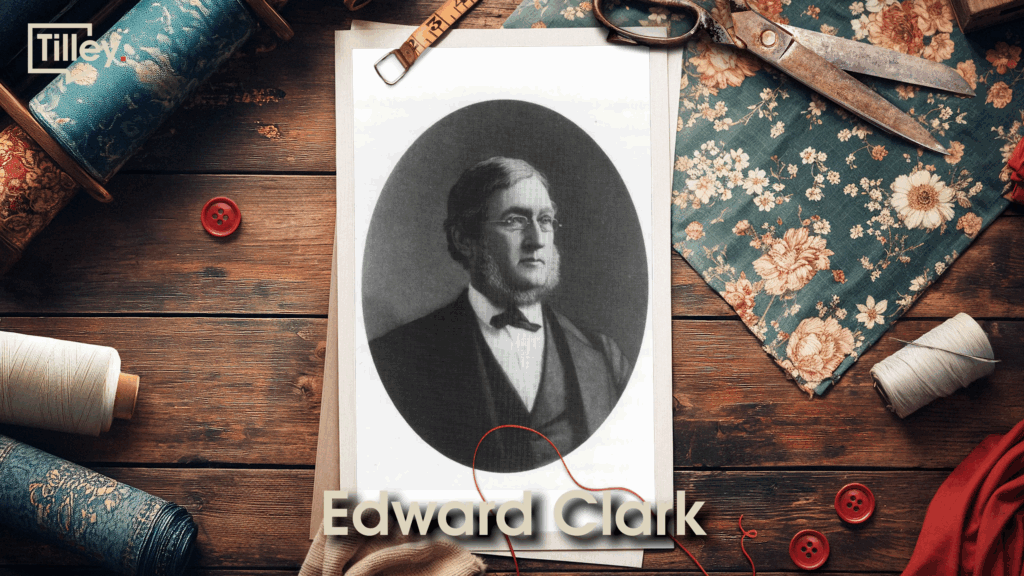
Clark’s legal talent and business discipline revealed themselves almost immediately. He brought order to the company’s chaotic finances, organized the patent strategy, and imposed a level of structure that Singer had never managed on his own. Yet that same competence intensified the internal friction.
The partnership among Singer, Edward Zieber, and Edward Clark was strained from the start. Zieber had put up the early money and worked beside Singer in the workshop, but he lacked Clark’s legal authority and Singer’s showman charisma. As the business grew more complex – and the stakes higher – Singer and Clark increasingly saw Zieber as expendable.
The Betrayal of a Partner
The opportunity came when Zieber fell seriously ill. While he was confined to his bed, Singer told Clark that the doctor expected Zieber not to recover. Singer then reportedly carried this claim to the negotiations, presenting the situation as urgent and irreversible. The two men used that manufactured crisis to pressure Zieber into selling his one-third stake for $6,000, a fraction of its true value even at that early stage.
Zieber eventually recovered – only to discover he had been pushed out of the enterprise he helped finance and physically helped build, and the worst part: by the man he convinced not to leave the company. From his perspective, Singer and Edward Clark had exploited his illness to seize his stake at a price far below its worth, and he was right. His resentment settled immediately and permanently into hatred. Yet the buyout stood, and the partnership reorganized into two equal owners: Singer and Clark.
But rather than stabilizing the firm, the new structure deepened the internal rot. Singer distrusted Clark because Clark’s calm, methodical style exposed Singer’s impulsiveness and financial recklessness. Clark distrusted Singer because he had seen, firsthand, the lengths Singer would go to in order to get his way – including the deceit used against Edward Zieber. According to several later accounts, Clark quietly admitted that he regretted participating in the removal of Zieber; it had given him a stronger position in the company, but it also tied him to a partner he neither respected nor believed he could ever fully trust.
The company moved forward with these two men locked together: equal in ownership, opposed in temperament, and bound by a decision that had poisoned their working relationship from the outset. Their collaboration generated enormous commercial success, but it rested on a foundation of bitterness and suspicion that never truly faded.
Clark’s Business Innovations
Over time, Clark proved far more capable than anyone expected. The company’s stability began with a major legal settlement in 1856. As the three dominant sewing-machine manufacturers – Wheeler & Wilson, Grover & Baker, and the Singer firm – fought each other in court, Clark negotiated a groundbreaking agreement to pool and share their patents. This arrangement, the first true patent pool in industrial history, required each company to pay $15 per machine for access to all essential patents. It ended what the press called the “sewing machine wars” and became a model later adopted in industries such as automobiles and radio.
Once the legal battles ended, growth accelerated with astonishing speed. The company sold 13,000 machines in 1860, overtook its two major rivals by 1867, and reached 127,833 units by 1870.
However, soon Clark realized the limitations of the factory market and the high price of the machines, and directed his energy toward the home users. Given the cost, he developed a program where people could rent the machines with a small monthly payment, and own them after a period of time. This was the first use of “installment plans” by a major American company, fundamentally giving birth to modern consumer credit.
Clark also revolutionized distribution. He realized independent sales agents often sold competitors’ models. So he switched to using only people who represented Singer exclusively, training them to demonstrate the machines. The company opened hundreds of offices across the states, creating one of the earliest “retail chains” in U.S. history.
We will talk in more detail about Mr. Clark and his management innovation in the second part of this series. For now, let’s jump back to the other founder.
After the Founders
While Isaac Singer spent money freely and lived without restraint – at one point riding around in the largest carriage in town, fitted with beds and even a toilet – Edward Clark kept strengthening the company with cautious planning and steady management.
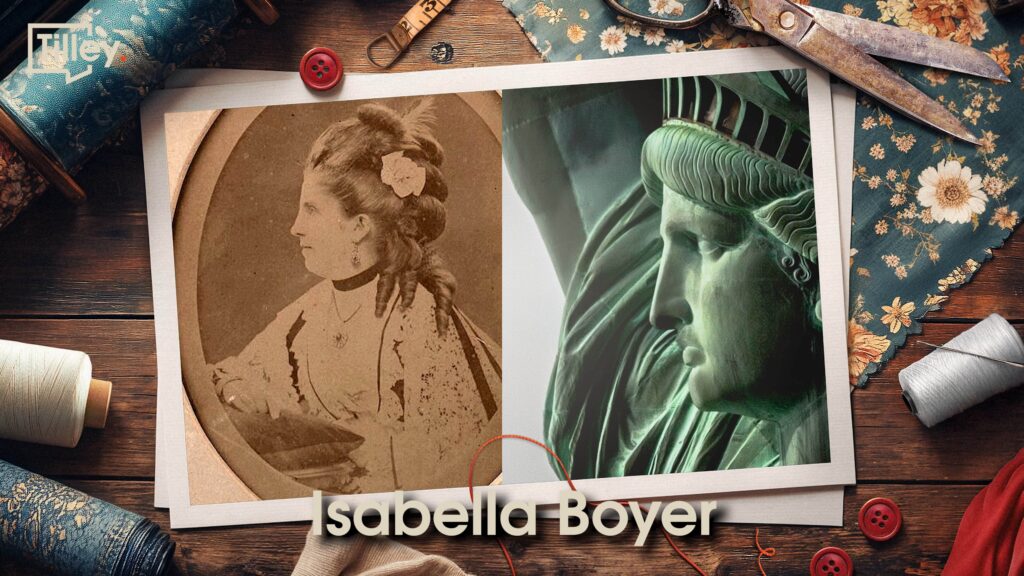
Singer’s personal life soon created enough scandal to drive him out of the country. After a public fight with Mary Ann, who learned he was involved with yet another mistress, he faced accusations of bigamy and adultery. He left the United States after divorcing his legal wife, Catherine (the one I mentioned in the beginning), and resettled in England. Just to remind you, Mary Ann was not his legal wife. In England, he married Isabella Boyer, who is said to have inspired the face of the Statue of Liberty, and had six more children with Isaac.
Singer and Clark never hid their dislike for one another. One was loud and theatrical, the other quiet and restrained. When the company needed a president, neither wanted the other in the job. According to the story, they told each other, “You can’t be president if I can’t be president,” and chose a young office employee instead.
Isaac Merritt Singer died in 1875 at sixty-three, leaving an estate valued at thirteen million dollars – well over three hundred million in today’s terms. He was buried in England and left his vast fortune to his twenty-four children. This allowed Clark to finally take the role of the president of the company.
Seven years later, Edward Clark passed away as well. His estate reached twenty-five million dollars. After both founders passed away, the company continued to grow. Improvements in mass production reduced the price of a sewing machine from $125 to $100, then $60, and eventually as low as $30. Lower prices opened the market to ordinary households for the first time. Massive factories in Elizabeth, New Jersey, and later in Clydebank, Scotland, produced machines at a scale never seen before. This marked the end of the era of two founders that hated each other, yet it was only the beginning for the company.
The Company Beyond Its Founders
By the early twentieth century, the company manufactured more than two million machines each year. Some estimates place its market share at eighty percent of global production well into the 1920s.

To signal its dominance, the company built the Singer Building in New York City. It opened in 1908 as the tallest skyscraper in the world, rising more than six hundred feet. Abroad, the firm constructed its ornate Russian headquarters in St. Petersburg, known as the Singer House. Because the city limited building heights, the architects placed a glass globe on the roof. Before the Bolshevik Revolution, the building briefly housed the American embassy. Today it remains one of the city’s most recognizable landmarks and serves as the home of the Dom Knigi bookstore.
By the 1920s, the company operated seventeen hundred stores in the United States and more than four thousand overseas, supported by a sales force of sixty thousand. The enterprise that Isaac Singer once tried to quit for fifteen hundred dollars had become a global industrial power.
The story continued into the 1960s, when the company joined the era’s corporate-merger wave. It expanded into calculators, aerospace, and defense, and its sales passed two billion dollars by 1969. Over time, this sprawling structure lost direction. And in the 1980s, the company was broken apart by corporate raiders, and the sewing-machine division was sold.
There is far more to the story, and I will cover the rest in the second part of this series. So make sure to check back soon to not miss the next article. And before you go – did you have one of these legendary Singer machines at home? Did you inherit one, or maybe you have an interesting story connected to it? Let me know in the comments below.