
What is your experience with DHL? Because I’m seriously upset.
I was planning a big camping trip, shipping my essential gear 2,500 kilometers from the Netherlands to Latvia (it’s in Europe, for those in the US). I chose DHL.
First problem: I landed in Latvia, and my gear was missing. DHL initiated checks that took over three weeks, and I almost missed my entire trip.
Second problem: When I finally returned home to the Netherlands, I got a delivery notification. The very same gear wasn’t handed to me; it was thrown over my fence, landing battered and wet in my backyard. They almost destroyed my equipment.
It felt like a total disregard for the customer. And it made me ask: Is this just me? Or is this a pattern with DHL?
For context, before I started writing this article, I thought “DHL” was Deutsche something – like an abbreviation for German Postal services or something like that. However, I was wrong. After researching for a while, I discovered that this is the story of three entrepreneurs who started the business from the ground up and built the world’s largest delivery firm. Sounds like a proper American dream story.
But then, during my research, I came across an interesting documentary: Shadow Billionaire. It’s about Larry Hillblom, he’s one of the three founders and the ‘H’ in the abbreviation. I watched it… and… my whole view of the company shifted.
So, I started digging – court documents, news reports, interviews, everything I could find. And what I discovered behind that clean yellow brand… surprised me, to say the least.
DHL shows us an image where everything is fast, clean, and perfectly connected. Carbon-neutral shipping by 2050. High-tech innovation labs. Robots delivering the future. But after reading all that… it comes out as yet another corporate bullshit.
If you’re new here, I’m Jeff Tilley. I explore how businesses operate, how they influence our culture, and everything happening in between. If you enjoy deep dives into the stories behind major brands, stick around and explore more articles on this site. Now, let’s jump into the DHL story!
The Fairy Tale Origin
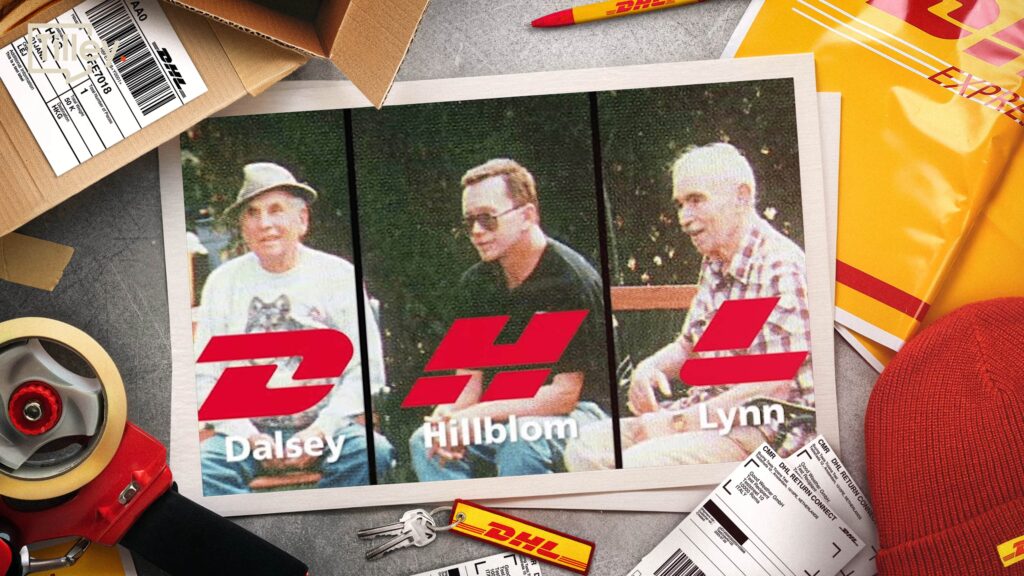
The year is 1969. Three American entrepreneurs – Adrian Dalsey, Larry Hillblom, and Robert Lynn – decide to start a company. Lynn knows logistics. Dalsey can sell anything to anyone. And Hillblom is a law student, the financial brain behind their ideas.
What they noticed was simple but huge: the world had a problem with document deliveries. If you had a crucial legal contract in San Francisco that needed a signature in Honolulu by the next morning, you were stuck. You had to wait for the slow process of registered mail or hope a commercial flight would take it as checked baggage, which was unreliable. Time-sensitive documents were the biggest problem of international business, holding up millions in capital and critical decisions.
The trio decided to create a bespoke service. They would personally fly the documents – often tucked into a briefcase and carried by a human courier on board a flight – and deliver them directly to their clients as soon as they landed. This was a brand-new service; nobody did that at a commercial scale at the time.
They named their venture after their own names: D-H-L (Dalsey, Hillblom, and Lynn).
Their early operations were unbelievably basic. The guys didn’t need warehouses or cargo systems for that – just a small rented plane or sometimes just a standard airline ticket. They just had to move fast. And somehow… that worked.
Within just five years, they pushed their network across the Pacific, then into Asia, the Middle East, and finally Europe. Since no one else offered similar services at the time, they were literally building a whole new market. As a result, DHL became the first true international air-express service, landing deals and building drop-off hubs in places where the local mail barely worked. They created a global web of speed and trust long before FedEx or UPS even realized the world could be connected this way.
At the center of that rocket-ship expansion was Hillblom. The lawyer with the sharp mind and sharper elbows. He wasn’t just negotiating deals – he masterfully let DHL slip past local red tape and scale across borders at a pace no one thought possible. He was brilliant, relentless, and ruthless enough to make that global vision real.
By the 1980s, DHL was everywhere. The yellow-and-red logo became a symbol of speed and global reach. The company was making millions, and this sounded like a success story for three entrepreneurs, and it indeed was. But the same network designed to deliver documents to anyone, anywhere, was about to become the ideal scene for one of its founders to become completely untraceable.
Dalsey and Lynn were known for their operational skills. But Hillblom, the man behind the money and the strategy, started to change. He was extremely wealthy, one of the earliest self-made billionaires. But instead of enjoying fame, Hillblom pulled away from the company and from public life. It may seem he was just going to enjoy a quiet life, but no… And this is where DHL’s polished success story is hiding a darker chapter.
The First Crack in the Image
Just as DHL was becoming a global powerhouse, expanding into every major region, Hillblom slipped quietly out of view. He stopped showing up at company meetings and quietly sold his shares while keeping his wealth and access to the DHL’s global network he built.
Hillblom moved to the Pacific and settled on a private island in Micronesia. On paper, it sounds simple: a rich man who’d won the game and just wanted privacy. The classic “early retirement on a tropical island” story. The official line was that he was a brilliant founder who got tired of the corporate rat race and went off the grid to find peace in the islands. The initial narrative was a classic success story: “I’ve made my fortune, now leave me alone.” That, however, was just the carefully managed public image.
Let me ask you a question. What happens when you’ve got access to virtually unlimited wealth, yet you are supposed to be bound by the rules of society, morality, and the law? For the ambitious young man who founded DHL, the answer was simple: You eliminate the bindings.
Now, apply that question to Larry Hillblom, the pioneering founder of DHL. The psychological shift was profound: the relentless, ambitious entrepreneur who revolutionized global air freight started operating without a moral compass, constrained only by his own immense desires. His staggering fortune didn’t just buy him comfort – it created a total moral vacuum around him.
Think about it:
- When you can buy silence, who can witness your actions?
- When you can disappear into your own private archipelago, who can track you?
- When you have engineered the very global logistics system that can move you and your assets across borders faster than any government or authority can follow…
…what constraints are left? The rules that govern everyone else simply cease to exist.
And guess what? This is exactly what happened to Larry. He decided to remove himself from the radars. His movements were known only to a few local officials he paid, and the private pilots who flew him between islands. It wasn’t even privacy. This was complete invisibility.
From the mid-1980s to the mid-1990s, the legend of the “Shadow Billionaire” began. While DHL was polishing its public image as a clean, fast, and reliable global courier, one of its founders was simultaneously living a life that went against every value the company promoted.
His huge wealth allowed Hillblom to create a space with no limits, no control, and no one who dared say no. He was incredibly smart and knew exactly how to avoid attention. There were whispers and rumors, but DHL’s corporate structure was designed to ignore them. Hillblom stayed far away, focused on his private life. The company stayed focused on growth, with Dalsey and Lynn remaining the public faces. And the DHL brand continued its global ascent.
But very soon, Hillblom’s intensely protected secret life would be violently ripped open, whether he wanted it to be or not.
The Perfect Accident
It’s 1995. The island of Saipan. On May 21st, Larry Hillblom takes off in his vintage seaplane, which he used many times before. But this time, the plane goes down. It crashes completely – the wreckage is found in the water. But Hillblom’s body is nowhere. Not even a trace left.
At first glance, it’s a tragic accident, but very suspicious. How could it happen that wreckage was recovered but no man inside? The official phrase was presumed dead. However, it was a clear disappearing act.
What’s interesting is that two years before his final flight, Hillblom crashed a seaplane near Saipan and survived. His injuries were so bad that he needed facial reconstruction, and doctors even removed a mole for a skin sample. Later, people started whispering that the first crash may have been a test run for faking his own disappearance, possibly with help from DHL pilots.
And what investigators discovered next made everything even stranger.
When police entered Hillblom’s home, they expected to find everyday items – razors, hairbrushes, toothbrushes, anything that could provide a DNA sample. They were acting on a court order, desperate to secure biological proof that could decide a massive, multi-million dollar legal battle that we are going to talk about in a second. But they found nothing. The house had been cleaned so thoroughly that it looked like someone tried to erase him from existence. No hair. No skin cells. Not even a stray fiber.
Hillblom’s team on Saipan didn’t just clean the house. They wiped it completely. Sinks were scrubbed with strong chemicals, and razors, combs, and clothes were buried in the backyard. Investigators called it “forensic sabotage” because there was no DNA left, no trace, no proof. One forensic tech said, ‘I’ve seen murder scenes cleaned less thoroughly.’ That was a professional body-and-soul erasure.
There is one interesting nuance here, which may shed some light on what happened. Two weeks before the crash, Hillblom suddenly changed his will to add a single line – any child proven to be his gets everything. If he had no children, his entire fortune would go to charity. Lawyers later called it the most expensive loophole in history – a ticking bomb he armed himself. He definitely knew the children were coming for his money.
And suddenly… the world learned he had not one, but multiple children. Four children from four different countries – the Philippines, Vietnam, Palau, and Saipan – came forward, claiming to be the offspring of Larry Hillblom. Their mothers were young women, often teenagers, from economically disadvantaged backgrounds. They had irrefutable stories, and the children bore an undeniable resemblance to the founder. They all told similar stories – they had brief encounters with the billionaire, small financial gifts, then silence.
With the founder’s body missing and his house wiped clean, the estate’s lawyers pushed back. They demanded proof. Real, scientific proof. But without Hillblom’s DNA, how do you prove paternity?
This is where the case turned into an international legal circus. Hillblom’s family refused tests for many years. So, the court approved a rare method: testing the children against each other. If they were truly Hillblom’s kids, they would share enough DNA to show they were half-siblings.
For the families involved, many of whom had very little money, this was an agonizing and immediate immersion into a global media storm. Yet, despite the immense pressure, labs in different countries tested the samples repeatedly, and the results were overwhelming and irrefutable.
Yes. The children were related.
Yes. They were Hillblom’s biological kids.
And yes, they were now the rightful heirs to his massive fortune.
The case was labeled the Hillblom Estate Battle. The co-founder of one of the world’s cleanest, most respected shipping brands had been living a double life. He was building a global company on one side, and secretly exploiting young women across the Pacific on the other.
The bright yellow DHL story now had a dark, human shadow behind it, one the company never wanted to talk about, but could never fully erase from its history. And kids were not the worst part of this story.
The Revelation of the Shadow Billionaire
This wasn’t merely a legal battle over an inheritance. The paternity case served as the devastating mechanism that dragged the billionaire’s hidden life, his true character, into the harsh light of the public domain.
The stories of the four mothers, painstakingly documented in court proceedings, detailed a pattern of predatory behavior. Larry Hillblom wasn’t just a “private” rich man; he was accused, in multiple jurisdictions, of a lifestyle built on systemic sex tourism. He would allegedly take what sources chillingly referred to as “sex safari trips” through Southeast Asia and the Pacific. He used his immense money and influence, and of course, the air travel access afforded by his former life, to operate entirely outside the reach of the law and moral oversight.
A really disturbing and ugly picture emerged during court records and interviews. The four mothers described almost identical experiences. They met Hillblom during his trips across Southeast Asia and the Pacific. At that time, they were very young and lived in deep poverty. So, it was not the story of an absent father but shocking evidence of a powerful man operating with near-total impunity.
Hillblom wasn’t just chasing young women; he looked for young girls as young as 12-14, driven by a paranoia about AIDS. Court documents revealed he paid “mama-sans” (bar madams) across the Philippines, Vietnam, and Palau to find pubescent girls for him.
One Palau bar owner described him as a regular who “kept mama-sans on the payroll to save young girls for him,” tipping $100+ per intro. Another mama-san testified she sold a 14-year-old girl’s virginity to Hillblom for $2,200 cash – the girl’s grandmother took the money and told her granddaughter it was ‘good luck.’ When she got pregnant, Hillblom flew her to Guam, paid for the abortion, and never spoke to her again. That was the standard package. A friend later bragged he’d bedded over 130 such girls in a decade.
Hillblom traveled frequently through the region, and according to multiple legal filings, his wealth and influence created an environment where no one questioned him. The imbalance was overwhelming. He was an American billionaire with private planes, lawyers, and global connections. The women who crossed his path had none of that – they were among the most vulnerable in their communities.
When the case was finally over, the outcome spoke louder than any testimony: $360 million divided among the four children. At the time, it was the single largest paternity settlement in history.
Just think: DHL says they are a company built on global connection, speed, and trust. But one of its co-founders lived a life that depended entirely on secrecy, distance, and power over the powerless. You might say, ‘Fine, DHL is a massive corporation run by thousands of managers; one shady co-founder shouldn’t represent the whole company.’ That’s what I thought, too. Until I started uncovering recent, active cases of discrimination, disregard for human dignity, and the same belief that money buys immunity. It’s the same toxic pattern of exploitation – it just moved from hotel rooms in Manila and Saipan to warehouses in Chicago and Milan.
Yellow Labor Hell
Let’s break down the recent legal history.
The United States: Racial Discrimination
The Hiring Barrier (2023): DHL paid $2.7 million after federal investigators found that their criminal-background screening unfairly rejected hundreds of Black and Hispanic job applicants. It wasn’t a small bias. It was a blanket rule that hit minority workers hardest. A hidden wall that blocked people from even getting in the door.
The Segregation and Safety Scandal (2024): This one was even worse. DHL paid $8.7 million to settle a case involving 83 Black employees who said they were segregated from white workers and forced into the hardest, hottest, and most dangerous jobs. White workers got the safer, cleaner roles. Black workers got the injuries, the heat, and the heavy lifting. That was the cost of the company’s progress. Discrimination with a fresh coat of corporate paint.
Europe: Tax Dodges and Worker Exploitation
Across Europe, the story shifts from discrimination to something more financial but equally harmful.
Germany, 2025. Inflation was rising, growth was near zero, and tensions exploded. Deutsche Post DHL went head-to-head with Verdi, the huge union representing 170,000 workers.
In January, Verdi launched a nationwide one-day strike. 13,800 couriers and sorters in Berlin, Hamburg, Frankfurt and more walked off the job. They demanded a 7% raise just to keep up with living costs. DHL answered with almost nothing – a pay freeze for three months, then only 2%, which didn’t even match inflation.
By June, 1,000 workers at DHL’s big Leipzig/Halle hub went on strike for several days, calling their wages “modern slavery.” Management tried splitting workers into smaller groups to weaken the movement.
Global Union Busting and Human Rights Violations
In other countries, DHL’s behavior was similar: punish anyone who speaks up.
Turkey: Workers tried to form a union. DHL immediately fired dozens of them. Courts later ruled every dismissal illegal. But the message was clear – if you are too loud, you’re out.
Latin America and South Africa: Employees reported being forced to take lie-detector tests. Not for security reasons but for control. These tests are unreliable, unscientific, and banned in many countries, but DHL reportedly used them anyway.
The company that promises fast global connection has built much of that speed on the backs of people who had little power to fight back. DHL’s bright yellow brand hides a darker system underneath, where workers are treated as replaceable parts in a giant machine.
But let’s move on.
The Court Graveyard
This list is a summary of just some of the company’s legal liabilities:
- 2009 – Smuggling: DHL pays $9.4 million for shipping hundreds of packages to Iran, Sudan, and Syria. No paperwork and zero accountability.
- 2021 – Shield Companies: Police seize €20 million from DHL’s supply chain for using fake partners to hire thousands at poverty wages while dodging taxes and benefits. Workers became invisible ghosts in the system.
- 2023 – Discrimination: $2.7 million payout after criminal background checks blocked hundreds of Black and Hispanic applicants.
- 2024 – Segregation: $8.7 million settlement to 83 Black workers in Chicago. They were forced into dangerous, gruelling jobs while white employees got easier, safer work. One worker said, “They sorted us by skin, and stacked the dark ones on the bottom.”
- 2025 – Labor scam: €46.8 million seized for the same labor scam – false contracts, exploitation, and tax fraud.
Around the globe, new lawsuits piled up: bullying executives, racial harassment, sexual harassment, unpaid overtime, and unsafe work conditions. DHL’s “speed and trust” happens at a human cost.
These aren’t the marginal mistakes of a busy logistics company. These are the documented, legally proven operations of a corporation that treats legal compliance as a suggestion and human rights as a negotiable cost.
The File Case Is Still Open
The empire was built by a man who vanished, a man whose body was never found, whose DNA was systematically erased, whose estate paid $360 million in paternal settlement for the kids he fathered during what sources call sex safari trips through Southeast Asia.
That same empire has paid tens of millions in settlements for racial discrimination in the US, treating Black workers as disposable and assigning them to segregated, dangerous jobs, effectively reinstating a form of labor apartheid.
Italian prosecutors have seized nearly €70 million twice – for labor exploitation schemes that treated workers like inventory items.
Courts across multiple continents have found their worker dismissals illegal, their union-busting tactics unlawful, their lie detector interrogations in violation of human rights standards. They shipped packages to sanctioned countries in violation of international law, and now face greenwashing fines for “eco” lies powered by coal.
This is a corporation with a courtroom graveyard longer than most crime families. The financial settlements, the court orders, and the testimony of the exploited are not errors in the system; they are the direct evidence of the system itself.
We may trust them with our valuable packages and their promise of speed, but what are we endorsing when we allow this history to be erased by a clean coat of yellow paint? What are we endorsing when we click “ship with DHL” during checkout on Amazon?
I got seriously frustrated, as you may have guessed. But what is your experience with DHL? Is it only me? Let me know in the comments below.
On that note, thanks for reading. If this story opened your eyes a bit, share it to help others see what’s behind the clean yellow brand. And if you want another corporate identity shaken, explore the history of Singer – a tale just as unexpected.