
Millions of people start their morning the exact same way: with coffee. It’s the universal reset button, whether it’s brewed in a moka pot, a French press, or a drip machine. But one method has always stood at the top: real espresso.
Thick, rich, concentrated, with velvet crema. It’s the base for every latte and cappuccino, a style baristas spend years perfecting, requiring a heavy, unforgiving machine.
And yet, somehow, this high-end, technical ritual ended up in millions of homes. Not because people suddenly became experts, but because one company figured out how to compress the entire experience into a small aluminum capsule and get us hooked.
As a long-time coffee aficionado who recently started my specialty coffee journey, I got curious. Why are these Nespresso capsules so popular? To my taste, it’s just a normal, slightly bitter coffee at the price of expensive high-end specialty coffee. What I found was something interesting: it’s not about taste or just marketing. It’s an odd mix of luxury experience, a genius business model, and state-of-the-art technology that brought Italian-style coffee to everyone’s home.
If you are new to this blog and want to know who’s writing this article – I’m Jeff Tilley. I explore how businesses operate, how they shape culture, and everything happening in between. If you enjoy deep dives that unpack the stories behind big brands, you’re in the right place.
So, want to see the real engine behind Nespresso’s success? Let’s take a closer look!
Brief History of Nespresso
Let’s go back to Rome in the mid-1970s. Busy streets, scooters everywhere, tourists wandering around the Pantheon, and espresso bars on every corner – pretty much what Rome still looks like today. But on this particular street, something stands out. There’s a small café with a line out the door, while five other cafés on the same block are almost empty. One place is packed. The rest aren’t. And nobody can quite explain why.
The café is Sant’Eustachio. It’s not fancy. It’s not serving artisanal single origins or hand-picked micro-lots. They use the same style of machines as everyone else, the same type of beans, the same rituals Italians have repeated for decades. And yet, Romans are ignoring all the competitors and queuing here. Every. Single. Day.
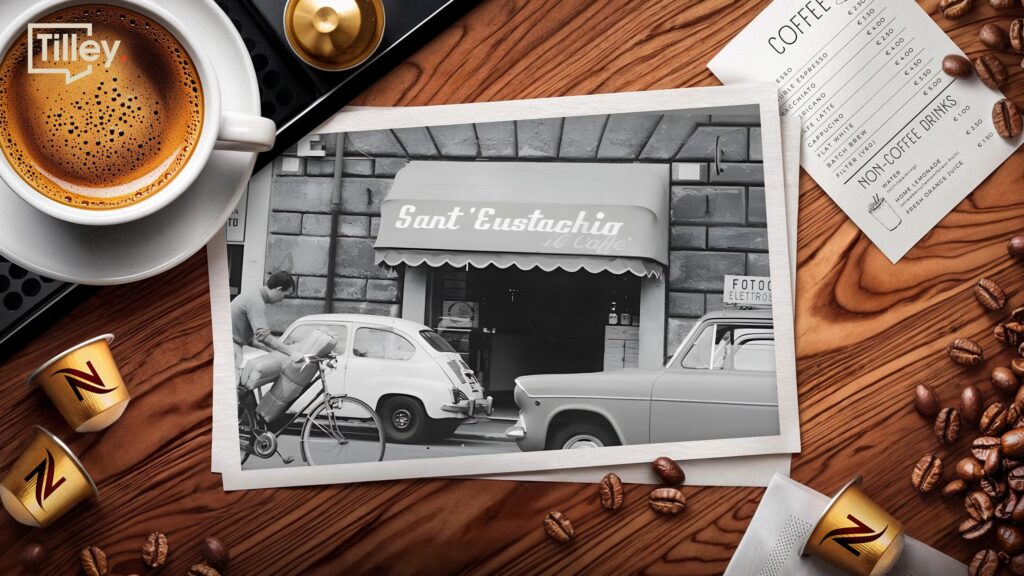
Standing in that line is a young Swiss engineer named Eric Favre. He works for Nestlé in the packaging division in Vevey, and he’s not in Rome to admire the fountains. He’s here on a mission pushed by two forces. First: a new job that demands innovation. Second: an Italian wife, Anna-Maria, who keeps telling him – without any hesitation – that Swiss coffee is terrible. In her world, real coffee comes from a bar, made by someone who knows what they’re doing. Every time she says it, Favre hears a challenge.
He does what engineers do when their pride is wounded: he looks for a design to fix the problem. The couple starts traveling across Italy, espresso bar after espresso bar, tasting everything they can, trying to understand what makes a “real” espresso so much better than whatever Switzerland is doing. And eventually, their quest leads them right back to the same mystery in front of Sant’Eustachio: why is the line here so long?
Favre watches. He observes. He compares. Same city. Same weather. Same machines. Same beans. But the results are different. Better crema, richer aroma, longer aftertaste. And the line outside the door proves Romans can tell the difference.
So he steps closer and pays attention – not to the flavor, but to the mechanics. Most baristas pull the lever once, maybe twice, and let the pressure do the work. But at Sant’Eustachio, the barista is doing something odd. He pumps the piston repeatedly before actually pulling the shot. A few short, rapid strokes that look almost accidental, until you notice every barista here does the same thing.
More pumping means more air forced into the coffee puck. More aeration. More turbulence. More oxidation. More emulsification of oils. The crema becomes thicker, almost paint-like. The aroma becomes sharper. The whole extraction changes character. Italians don’t analyze it. They simply know: “This bar is better.”
But Favre is an engineer. That tiny, almost invisible detail – the extra pumping – becomes the origin seed of the entire Nespresso system. For Favre, the question becomes almost obsessive: if this barista can create a superior espresso by altering the physical workflow, why can’t a machine do the same thing? Why can’t you engineer the perfect barista moment into a controlled device?
The Technology of Standardized Perfection
If the history of Nespresso begins with a barista pumping a lever in Rome, the technology begins the moment Eric Favre goes back to Switzerland and decides to do something very few people in Italy would ever dare: treat espresso like a mechanical problem instead of an artistic ritual. Italians talk about crema the way sommeliers talk about wine. Favre looks at it and thinks, “I can replicate that.”
He takes that tiny detail he observed at Sant’Eustachio – the repeated pumping, the extra aeration, that little dance before the shot – and strips all the romance away. The barista isn’t a magician. He’s just manipulating physics. More air. More pressure. More turbulence in the puck. More oxidation. Result: more crema. The espresso looks thicker, smells stronger, hits harder. Italians just accept it as “the good place.” Favre reverse-engineers the cause.
Back at Nestlé, he asks the most un-Italian question he could possibly ask: “How do you trap this effect inside a machine a normal person can’t screw up?” No flair. No intuition. No guesswork. Just repeatable quality, low effort, high speed, and a guarantee of freshness. His answer is ruthless standardization. Lock the dose so nobody overfills or underfills. Lock the grind so nobody uses the wrong texture. Lock the pressure so nobody tampers badly. Lock the water path so nobody floods or chokes the puck. And once everything is locked, seal it – hermetically – so oxygen, humidity, and human error can’t ruin the coffee.
That sealed little pod becomes the heart of the entire system. A tiny pressure capsule containing exactly the right amount of coffee for exactly the right extraction curve. When the machine pierces it and pushes hot water through, the system forces air, water, pressure, and resistance to dance in the exact same pattern Favre saw at Sant’Eustachio. Except now it happens on demand. No barista and no skill needed.
By 1976, Nestlé patented the entire concept: single-portion capsules and a new type of high-pressure extraction that injects air and water in a controlled, repeatable way. It’s an incredibly futuristic idea for its time. On paper, it looks like Nestlé has just invented the espresso machine of the future. In practice, it’s a disaster.
The first prototypes are enormous. Stainless steel tanks, heavy pipes, and industrial pumps. They look less like kitchen appliances and more like something you’d wheel onto an airplane for inflight catering. Nobody – and I mean nobody – is putting that on a home counter. Nestlé treats the whole thing exactly the way large corporations treat clever R&D experiments: like a B2B convenience tool. They pitch it to offices, airlines, and restaurants with the energy of someone selling a fancier water cooler. “Your employees will get slightly better coffee.” That’s the big idea.
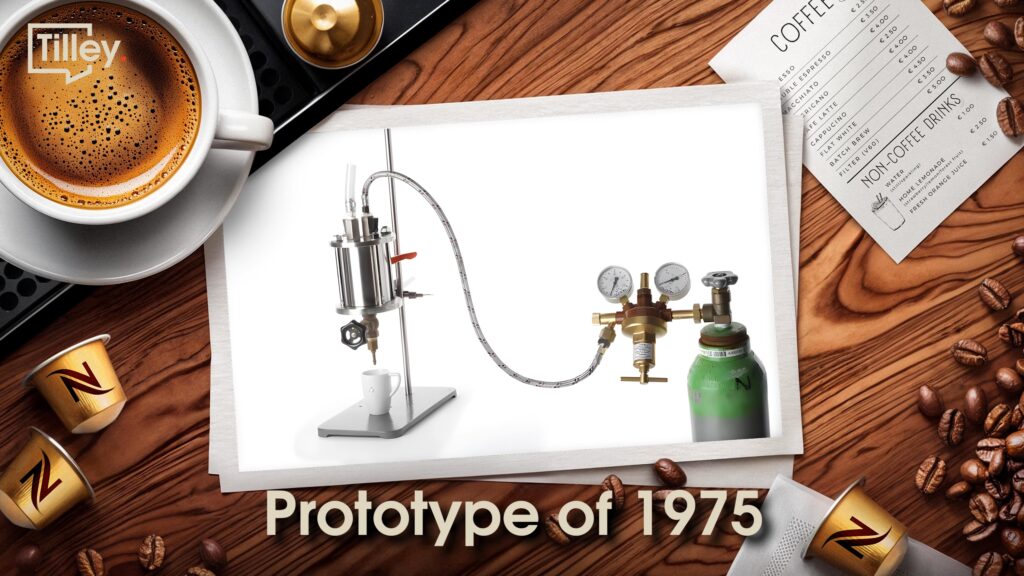
And the market reacts with a resounding shrug. The espresso is good, but the framing is boring. There is no romance, no ritual, no story, no desire. It’s a technical solution searching for a human problem. For almost a decade, the entire Nespresso system sits in the corporate basement like a forgotten prototype that only the engineers still believe in.
Technology is revolutionary, but technology alone never wins. It needs context. It needs relevance. It needs someone who understands how to turn engineering into desire. And that person – the one who will drag Nespresso out of obscurity and put it into your kitchen – hasn’t entered the story yet.
The Luxury Experience and the Pivot
The problem with Nespresso at the time was that adoption was slow. Internally, Nespresso looks like a respectable, harmless, quietly dying side project. Some R&D achievements Nestlé can brag about at innovation conferences. Favre has done his job. He’s proved you can industrialize the Sant’Eustachio trick. But nobody has yet answered the real question: Why would a normal person ever choose this? Why would it belong in your home instead of a hotel back office?
And this is where the story shifts.
An answer doesn’t come from an engineer at all. It comes from someone who spent his early career marketing cigarettes.
In the late 1980s, Nestlé brings in Jean-Paul Gaillard, a man who looks at consumer behavior the way a sniper looks at wind direction. He doesn’t care about water pressure curves or aeration physics. He cares about positioning, status, margins, mood. He takes one look at Nespresso and in a single breath sums up the entire problem: the technology is fine, the target is wrong, and the story is dead.
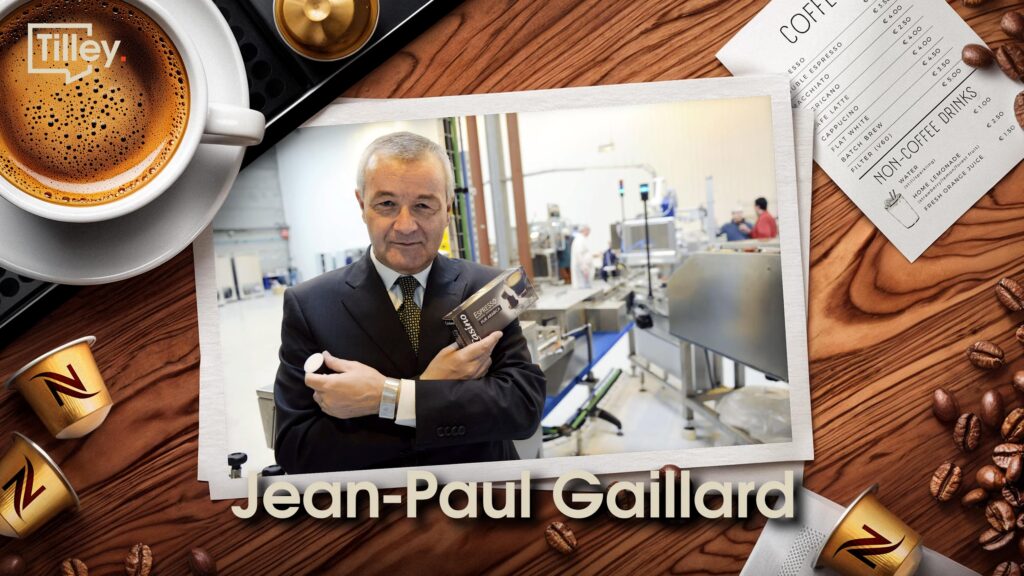
Later in interviews he says, “I wanted to create the Chanel of coffee… to keep it chic, for people who have a doorman.” It sounds outrageous, almost arrogant. But underneath it is a brutally simple strategy: stop thinking like a food manufacturer. Start thinking like a fashion house.
Gaillard flips everything Favre’s team has done on the business side. Nespresso stops pretending to be a corporate utility and starts speaking directly to home users. And not just any home users – aspirational, urban, upwardly mobile consumers who like their objects polished, their kitchens minimalistic, and their experiences effortless. The message becomes: “You don’t have to go to a barista. You are the barista now. You just press one button.”
To make that believable, the machines shrink. They become attractive. Sculptural. Designed. And instead of Nestlé trying to build hardware itself, Gaillard hands that part off to brands people already trust: Krups, Magimix, De’Longhi, Alessi, Philips, Siemens. Nespresso keeps the soul, the capsule, the ritual. The partner brands build the body.
Suddenly it’s no longer “Nestlé hardware.” It’s something that sits on your counter and whispers, “I buy premium things.” And later, when we get into the business model part, you’ll read why making the hardware beautiful and accessible isn’t a design choice – it’s a trap door.
Then Gaillard builds something Nestlé never had before: a club. Not a loyalty program, not a newsletter – an identity. Le Club Nespresso. You don’t buy capsules; you join. You get catalogs. Order hotlines. Later, dedicated boutiques. Nestlé, for the first time in its corporate life, has a direct database of individual customers and their exact coffee habits. For a food giant that mostly sells through supermarkets, this is a quiet revolution.
And then comes the move that locks the entire “premium universe” narrative into place. Nespresso steps into physical retail – but on its own terms. No supermarkets. No crowded shelves. No competing brands next to them.
In 2000, they opened the first Nespresso boutique in Paris. A temple of capsules. A jewelry store for caffeine. Not a grocery aisle. Not an electronics corner. A mono-brand space dedicated solely to this ecosystem. Capsules arranged like Pantone swatches. Staff trained to talk about intensity, origins, aroma profiles, and “Grand Cru” blends. Machines displayed not as appliances but as design pieces under soft lighting.
By the early 2010s, there were hundreds of these boutiques across the world. Nestlé – one of the most mass-market companies on earth – somehow builds a global luxury retail network for coffee pods. It’s the kind of thing that would make an LVMH executive nod respectfully.
And then comes the face of the brand. George Clooney. A choice so sharp you can practically hear the knife hit the cutting board.
Clooney isn’t youthful or hyper-cool. He’s sophisticated, charming, quietly glamorous – the human embodiment of “I don’t rush for anything.” The ads don’t sell machines. They sell attitude. Nespresso becomes cosmopolitan, ironic, slightly self-aware, and unmistakably premium. Clooney walks into a boutique, gets half-ignored, trades coffee for knowing glances. The plot is irrelevant. What matters is the world around him: a place where Nespresso is the default beverage of refined people doing refined things in refined spaces.
And all of this – the boutiques, the club, the positioning, the casting – sets the stage for the real secret behind Nespresso’s empire. Because the brand experience isn’t just aesthetics or lifestyle. It’s the front end of a business model so elegant and so profitable that other industries still study it today.
The Genius Business Model of Nespresso
And this is the part everyone underestimates. Nespresso isn’t built on technology, or taste, or even convenience. It’s built on a business model. A model so powerful it hides in plain sight, dressed up as a lifestyle, wrapped in shiny aluminum, finished with a perfect crema. And the truth is, the model itself is older than espresso.
To understand Nespresso, you have to go back to a man who passed away decades before the first capsule existed: King Camp Gillette. Yes – the razor guy. Gillette didn’t invent shaving; he invented the idea of giving you the cheap part today so you’re forced to buy the expensive part tomorrow. Or at least, he made this business model popular. We’d hand you the handle, practically free. And the blades – this is where all the money is. And once you own the handle, he owns your bathroom for life.
That basic logic – hardware at cost, consumables at a premium – became the blueprint for everything from instant cameras to inkjet printers, game consoles, and eventually… coffee. A Fujifilm Instax camera is basically a plastic toy, but the film costs more than your dignity on a Monday morning. Printers are practically free, but ink cartridges are liquid gold. Amazon sells you a cheap Kindle because all the real margins are locked inside the Kindle Store.
So in the 1990s, when Jean-Paul Gaillard looked at Nespresso – a failing office appliance project gathering dust inside Nestlé – he didn’t see a coffee machine. He saw the greatest razor-and-blades opportunity the food industry had ever overlooked.
Gaillard didn’t copy the model. He weaponized it. As I already mentioned, his first move was to cheapen the hardware on purpose. Machines became smaller, prettier, friendlier, licensed to brands people already trusted – Krups, De’Longhi, Magimix, Alessi. Nespresso didn’t have to become a hardware manufacturer. Other companies did it for them. Suddenly the “luxury” coffee machine was no longer a thousand-euro appliance; it was an impulse buy. The entry point to the ecosystem became effortless.
His second move was to lock the consumable. Every capsule became a tiny aluminum micro-payment you make every morning, maybe twice, maybe three times, depending on how badly your boss stresses you out. And those capsules are only available from Nespresso. Only through Nespresso channels. Only inside the Nespresso ecosystem. There were no supermarket alternatives, no price competition, no discounts. If you wanted your morning shot, you paid the Nespresso price. The average user never noticed they were stepping into supply-chain captivity with the elegance of a luxury brand and the ruthless discipline of a software monopoly.
And then Gaillard added the velvet handcuffs. He created Nespresso Club, boutiques, limited editions, seasonal flavors, “Grand Cru” collections. You didn’t just reorder coffee – you “discovered new aromas.” You didn’t pay for shipping – you enjoyed “exclusive Club delivery.” You weren’t buying consumables – you were “curating your tasting experience.” Gillette sold necessity; Nespresso sold identity.
The trap was beautiful. The machine was cheap. The pod was expensive. The lock-in was invisible. The experience felt premium. And every morning, before your brain even boots up, you feed the machine again. Nestlé doesn’t need to guess your coffee habits. They know them. Capsule by capsule. Order by order. Data point by data point. Even Apple looks at this with respect: a perfectly closed ecosystem with repeat purchases, luxury framing, and disturbingly loyal users.
Nespresso built the most seductive, seamless, bourgeois version of a subscription business the world has ever seen – a razor-and-blades engine disguised as culinary sophistication. They made recurring revenue feel like self-care.
People think they’re buying a coffee machine. What they’re actually buying is a subscription, a luxury habit, a long-term dependency, a premium identity, and a lifetime of repeat purchases. All bundled into one beautiful little aluminum pod.
Conclusion
So Nespresso really is a strange hybrid. The technology is genuinely pioneering. The brand experience is closer to luxury fashion than anything in the food industry. And the business model is basically Gillette with better lighting. On its own, none of this is new. Capsules existed. Espresso existed. Razor-and-blades existed. But Nespresso stitched it all together in a way nobody else had – and that’s what changed the morning habits of millions.
Which makes me wonder about one thing: what does this look like from your kitchen? Do you have a Nespresso machine at home? Are you a filter-coffee person? Or are you, like me, already deep in the specialty-espresso rabbit hole? Let me know in the comments below.
On this note, thanks for diving into this story with me. And if you want another brand story with twists, strategy, and surprising moments, head over to my Dr Pepper deep dive. I’m pretty sure it’ll hook you too!