
What are you wearing right now? Hopefully, you’re reading this article with your pants on and something like a shirt, and perhaps a sweater or a hoodie. We consider clothing a basic necessity, and we don’t think twice about our fundamental right to walk into a store and buy something to wear.
Yet, it wasn’t always that simple.
Back in the day, women would sew clothes for the entire family, manually, by hand. To produce a single shirt, even for an experienced tailor, could take as much as 14 hours of labor. To fix this exhausting problem, a company co-founded by Isaac Merritt Singer invented the sewing machine. (I have a whole article about him; I strongly encourage you to read the first part before diving into this one!)
The sewing machine: an invention that is arguably the single most important and fundamental invention to ever impact our day-to-day lives – even more than the steam engine. I am serious.
Now, imagine what life looked like for the average housewife in the 1840s. Her task wasn’t just to sew, but to cook for multiple children, clean the house, and care for the family. The sewing machine was an invention of emancipation. I wouldn’t exaggerate if I told you that the company Singer was the single biggest contributor to women’s liberation – more than any politician or any other human being on Earth.
Singer wasn’t the first company to invent a sewing machine. They didn’t even own many of the key patents they used early on. But they did something far harder: they took this complex piece of equipment and brought it into the hands of ordinary people, making their name synonymous with sewing itself.
At the time, there was no infrastructure. No railroad, no phones, no trucks to deliver goods. Accounting was based on large paper ledger books. The company had to carve its way to the market, and while doing that, it had to invent ways to expand, fund its growth, sell appliances that were virtually unaffordable to the average household, and find a way to manage a huge empire of tens of thousands of employees – all without emails and without Zoom calls.
But let’s not rush the conclusion. Instead, let’s dive into how the company became the global behemoth we know today – a brand that has been with us for more than 170 years.
If you’re new to this blog, I’m Jeff Tilley. I explore how businesses operate, how they influence our culture, and everything happening in between. If you enjoy articles that explain the world behind the brands, I’m sure you’ll find this deep dive fascinating.
So grab a cup of coffee, settle in, and let’s jump into the story of how Singer quietly built the modern world!
Innovation 1: Consumer Credit
It’s the early 1850s. The company had just invented its improved sewing machine, which worked better than any competitor’s model. But there was one massive roadblock: it was very, very expensive.
A basic Singer sewing machine cost about $125. To put that price in perspective, the average American worker in the 1850s made less than $500 a year. Think about that: the machine cost a quarter of their annual income! That’s like paying for a down payment on a house or buying a luxury car today. And a seamstress, who was their perfect customer, barely made enough money for rent and food.
The challenge was clear: Singer’s product was too expensive. Most families simply couldn’t afford it. Only wealthy households and industrial workshops were buying.
Edward Clark knew the company needed a steady cash flow to survive. So, in 1856, he introduced a revolutionary idea: the “hire-purchase” plan – what we now call consumer credit. The innovation itself was simple, brilliant, and completely game-changing:
For just $5 down and a small monthly payment of $3 to $5, a family could take the machine home immediately. This move instantly shattered the psychological barrier. Now, customers didn’t focus on the prohibitive $125 cost, but only on the small, manageable monthly payment. That quarter-year salary purchase suddenly felt like an affordable subscription.
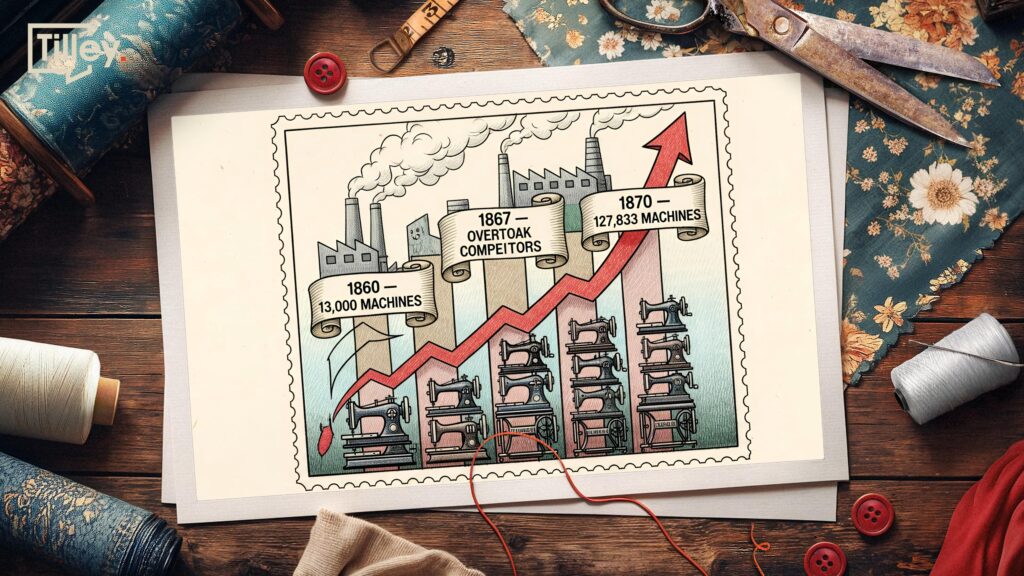
It was an instant success. Sales tripled within a year. By the 1870s, 70 to 80% of all Singer machines were sold this way, on these installment plans. Singer unlocked a massive, previously inaccessible market – the working-class home. But there was a problem.
Computers hadn’t been invented yet, so a manager couldn’t just create a nice Excel table for all the loans, or, as they called them, hire-purchases. They needed a way to track thousands of small payments.
So, they created the first credit database, which consisted of millions of individual, handwritten payment cards. These cards were stored and indexed in massive wooden cabinets globally and tracked the payment history of every single customer. That was the world’s first true consumer credit database! Modern credit bureaus owe their existence to this system.
Here’s how it worked. The machine was considered “hired” until the final payment was made. If the customer missed three payments, special collection agents – in fact, the same salespeople who sold the machine – politely but firmly took the machine back. Repossession was an essential component of this business model. It allowed Singer to mitigate risk, keep the resale value of the machine high, and recycle the asset by selling it again.
Singer even invented a simple form of credit scoring. If you owned your house, you often paid less per month; if you were a renter, the down payment or monthly rate might be slightly higher to cover the potential risk. This was risk-based pricing – a century before modern credit scores existed.
The company even added gamification elements to their credits. In markets like France and Latin America, they experimented with selling lottery tickets with the machine. Every month a payment was made, the customer entered a draw to win their remaining debt canceled. This was the first example of gamification of finance in the 1880s!
Singer fundamentally changed the psychology of consumption and established that the value of a product is measured not by its total cost, but by the affordability of its payments.
But this invention brought another challenge – now everyone wanted the machine. And the company needed to meet this insane demand.
Innovation 2: Mass Production
They needed far more machines than their old, workshop-style factories could produce. Singer had to make production much cheaper and more consistent.
In 1867, they opened the huge Clydebank factory in Scotland. It was one million square feet of production under one roof – the largest factory in the world. But the size wasn’t the only impressive part. Here, Singer introduced the basics of continuous flow manufacturing.
This system was essentially an adaptation of the American System of Manufacturing, whose principles – like interchangeable parts, jigs, gauges, and division of labor – were imported from the U.S. government arms industry. Singer specifically hired engineers who had worked under the system’s pioneers, such as Simeon North, Eli Whitney, and Col. John Hall. These engineers then adapted and expanded those techniques to fit Singer’s sewing-machine production. The company’s unique “conveyor” wasn’t a modern powered belt, but a staged, mechanized system using racks, wheeled carriers, and mechanical conveyors to move subassemblies.
They built moving conveyors where parts traveled through the factory, allowing workers to stay put while the components came to them. As one worker described in 1890, “The parts move past us on rails – we never walk.” The factory relied on thousands of machines, each designed for one precise task. This extreme specialization ensured the parts perfectly fit each other, which was critical for mass production.
The company invented special production schedules – they timed each step with stopwatches and broke tasks into small parts. It was an amazing example of production optimization.
Frederick Winslow Taylor—the man who officially created scientific management – visited Singer’s factories in Clydebank and Elizabeth, New Jersey, multiple times. He took notes on their workflow, tool specialization, and management methods. Many ideas in his famous 1911 book The Principles of Scientific Management came directly from what Singer was already doing.
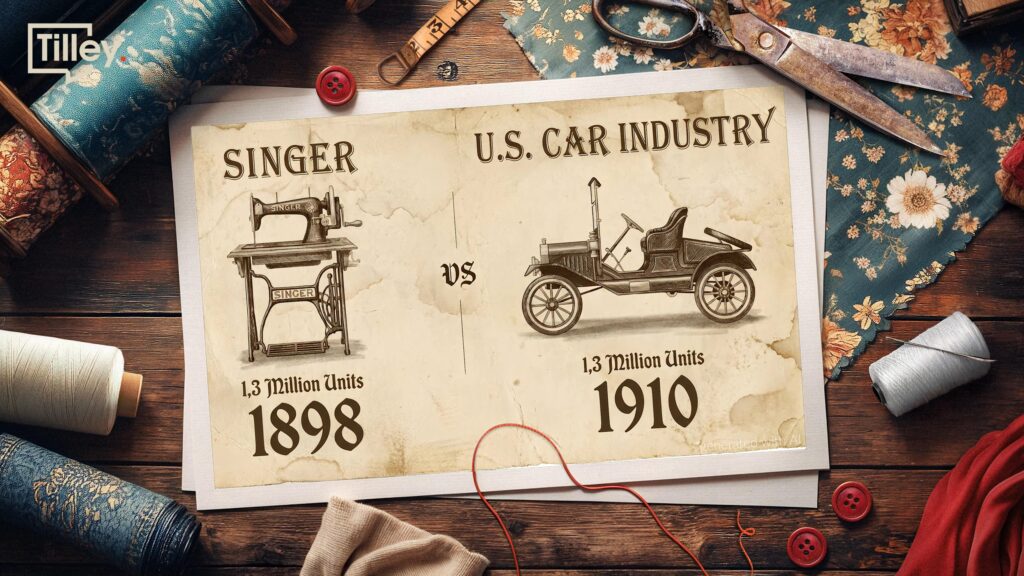
That system brought astonishing results. By 1898, the plant in New Jersey alone produced 1.3 million machines in one year. The total production volume of the U.S. car industry didn’t reach that level until 1910. Singer made mass production efficient, standardized, and scalable, laying the groundwork for every major manufacturing industry that followed.
But there was a major catch: lack of people. While the company was rapidly growing and expanding its reach, they needed more and more skilled workers. The social welfare system was almost non-existent at the time, and it couldn’t supply a steady stream of workers to the factories. As a result, it was critically important for the company to keep their educated employees from leaving while keeping hiring at a steady pace.
Innovation 3: Welfare Capitalism
In the late 1800s, factories faced frequent strikes, unstable labor markets, and workers who often changed jobs, creating a critical challenge for rapidly expanding companies like Singer. The core problem was how to create a stable, loyal, and skilled workforce that would stay with the company for life, especially when the market lacked a reliable supply of educated labor.
The high rate of turnover meant companies were constantly losing their investment in training, and the continuous need to hire and train new people was extremely expensive. This unstable labor pool, compounded by workers frequently leaving for better wages, threatened Singer’s massive, high-precision manufacturing operations.
And Singer’s answer was an innovation far ahead of its time, something we’d call today welfare capitalism.
The idea behind welfare capitalism is simple: a company takes care of its workers’ well-being, tying them to the company through comfort, security, and community. Singer did this brilliantly.
Singer didn’t just build factories; they created whole communities:
- In Clydebank, Scotland, they built 3,000 homes complete with running water, sanitation, a company hospital, schools, libraries, stores, and sports facilities.
- In Podolsk, Russia, they had a theatre, a technical college, and even an orphanage for workers’ families – and this was back in 1902!
- In Wittenberge, Germany, the factory town included a kindergarten and a swimming pool.
Workers enjoyed special benefits everywhere:
- 8-hour workdays in the 1890s, long before they became the norm.
- Pensions starting in 1905, decades before Social Security.
- Company doctors, free milk for mothers and children, and savings loan programs.
Singer was also a pioneer in employing women. They hired tens of thousands of women for their factories and made sure they had respectful work environments. Women were given dedicated restrooms and cafeterias, and the company even offered early forms of maternity leave.
By 1880, Singer already understood the value of investing in people. You might think this was just charity, but it wasn’t; it was a calculated, sophisticated management strategy. It drastically cut down on turnover, reduced the motivation for unionizing, and built a community whose identity was immediately tied to the Singer brand. Simply put, a healthy, educated, and loyal worker is a more productive worker who makes fewer errors on high-precision tasks.
Today’s corporate culture, elaborate benefits, and massive company campuses – like Apple Park or Googleplex – are all following the same blueprint that Singer pioneered with welfare capitalism. And this would have nicely continued if not for the rising overhead costs that needed to be covered by ever-growing sales.
Innovation 4: Marketing
In the late 1860s, Singer already dominated the market of corporate clients who manufactured clothing. But by the 1890s, they dominated the household market with their more affordable machines. They needed to go further. They had to convince every family that didn’t yet own a Singer machine to buy one, in order to sustain their massive growth. The question became: How do you convince every single household, from urban New York to rural China, that they need this large, expensive machine? They needed global, pervasive brand advertising.
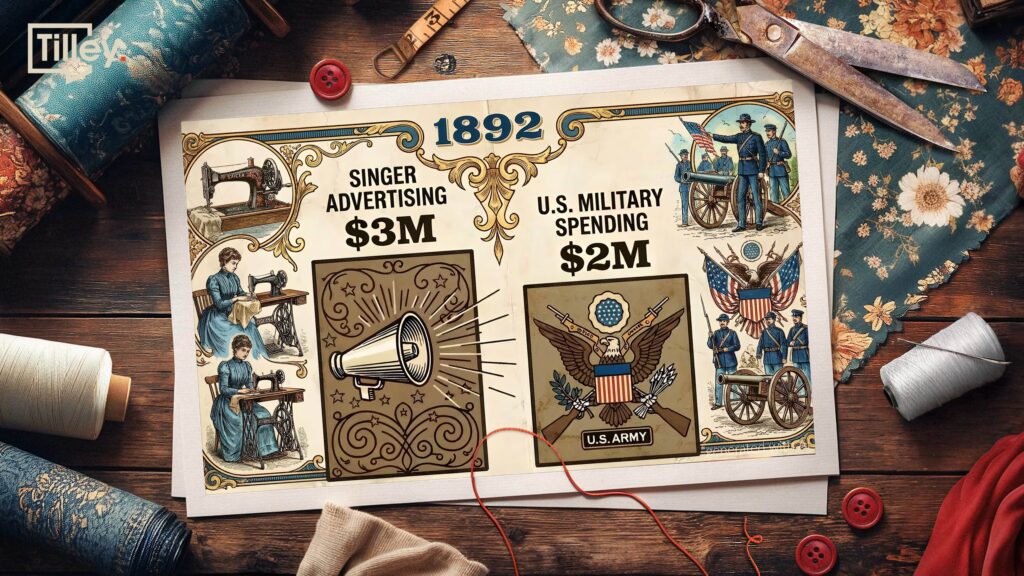
In 1892, Singer spent a documented $3 million on advertising. This was more than the U.S. government spent on its entire military that year – a truly staggering investment. Singer was a media powerhouse!
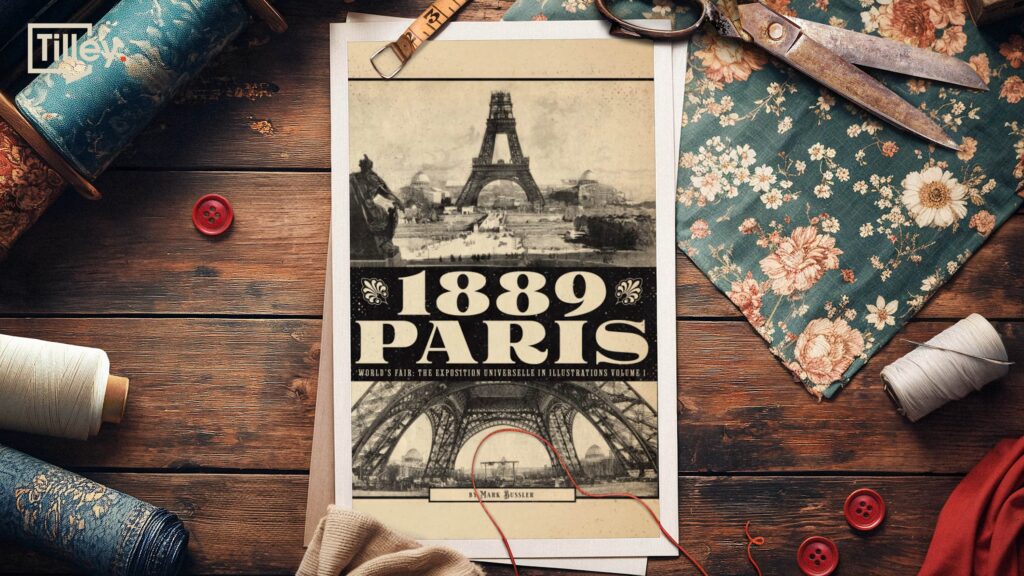
They sought highly visible, iconic placements. They famously sponsored the illumination and lighting of the Eiffel Tower during the 1889 World’s Fair to associate their name with modern progress and spectacle.
Singer’s sponsorship of the Eiffel Tower’s lighting was a masterstroke of early publicity. The Eiffel Tower, built as the entrance arch for the 1889 Exposition Universelle in Paris, was the world’s tallest structure and the ultimate symbol of industrial power and the modern age. By paying to illuminate it, Singer essentially bought the world’s attention.
The nightly light show was a major attraction that drew millions of visitors. By ensuring that their brand was associated with this technological marvel – a structure that was beautiful, functional, and massive – Singer positioned itself as a company of the future. This move leveraged the global media coverage of the event, broadcasting the Singer name and implied progress to audiences worldwide without having to rely solely on local newspaper ads.
At the 1893 Chicago World’s Fair, they continued this dominance by building a massive, distinctive 20-meter-high Singer pavilion and became the most visible industrial brand at the global event. They strategically donated machines to schools, orphanages, and trade institutions worldwide, creating a new generation of skilled users already comfortable with the Singer product.
But Singer’s advertising went even further than that; they knew that even if the product was the same everywhere, the message had to feel local.
Let’s look at their famous “Red S Girl” campaign. It was an early form of mass media marketing and collectible branding. Singer printed around 30 million colorful trade cards – small, stiff cards, often used like business cards today – that featured a girl. These were so attractive they quickly became collectible items that people would save and trade.
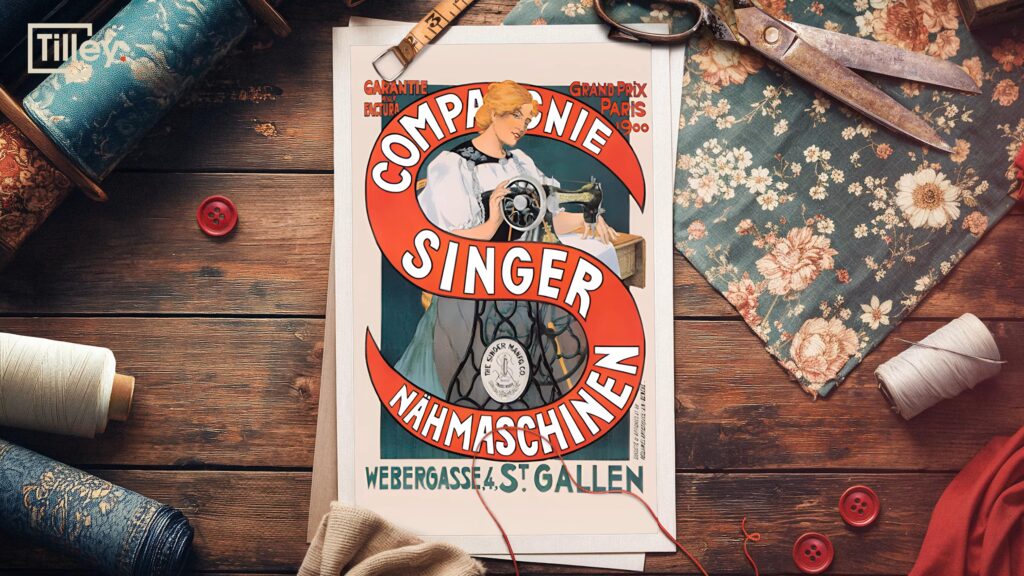
The Red S Girl campaign became iconic because it was one of the first successful attempts to create a universal, yet adaptable, brand mascot. She was designed to embody the specific benefits of owning a Singer machine: skill, domestic work, and reliability. She became a powerful symbol of the modern, capable homemaker – a woman empowered by technology.
What made it so iconic was that the character was customized for every market. For example, in Japan, she wore a kimono. In Turkey or North Africa, she wore a traditional headscarf. In Africa, she was shown wearing beads and local dress. This strategic customization was revolutionary.
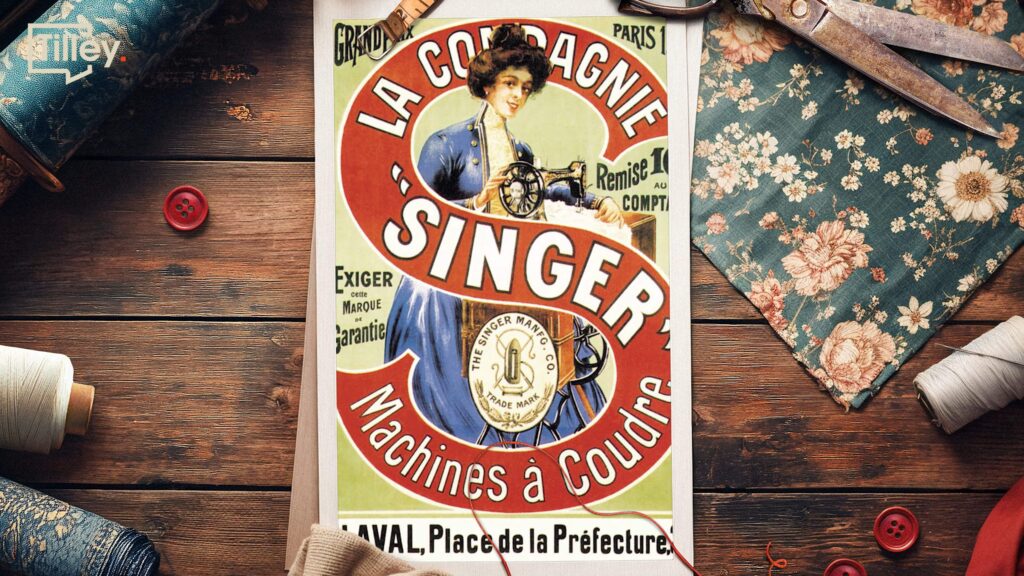
Singer performed a deep cultural adaptation. By adjusting the image to reflect the local culture and social norms, Singer instantly built a sense of trust and familiarity. Customers felt the company understood their specific life and home, reducing the psychological barrier of buying a foreign machine. This is the core concept behind hyper-local marketing, a strategy that major global brands like Coca-Cola and IKEA rely on heavily today. Singer truly mastered this technique decades ago, making the Red S Girl an icon of early international branding.
Singer provided a playground for many founding fathers of modern marketing.
For example, Claude Hopkins, who invented “scientific advertising” and created the famous Pepsodent slogan, “Brush your teeth to remove the film!” He started his career writing newspaper ads for Singer.
Or John E. Kennedy, the man behind “reason-why” copywriting – the idea that every ad needs a clear, logical reason for someone to buy. He honed his skills selling Singer machines.
Just look at the pictures Singer made to sell their machines! They were so pretty and colorful. They used a special way of printing called a lithograph. It made the pictures look like real paintings. People loved them so much they would put them in frames and hang them on the wall like artwork! That meant the Singer ad stayed in the house forever. Singer was the first company to learn how to make their name known all over the world and how to make people feel good about buying their things.
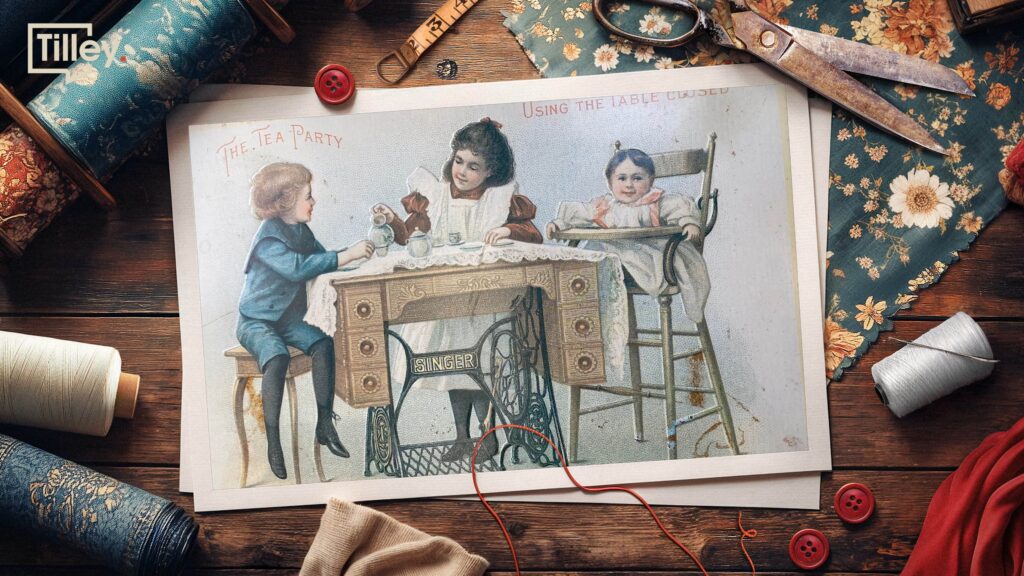
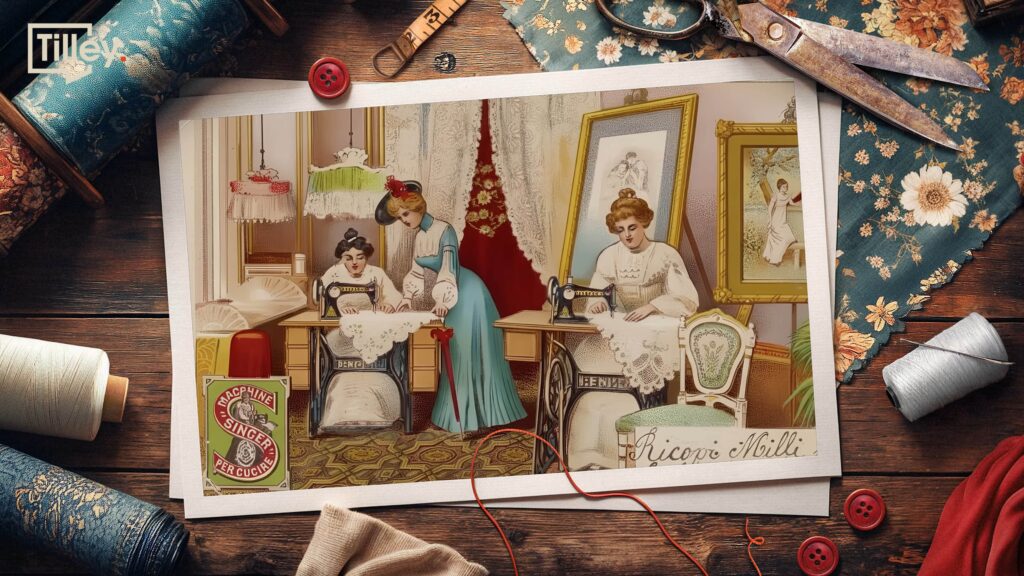
Yet, along with exceptional advertising and a rise in Singer’s brand recognition, another challenge was raised. The sewing machine was a very novel concept for the time. Think of your parents and their smartphones. It took one full generation to adopt that technology. Exactly the same happened with sewing machines – someone had to show and explain how they work.
Innovation 5: Sales Army
Selling the sewing machine was complex. The process had three critical parts:
- Demonstration. It was a high-tech product that required a captivating, in-home demonstration to prove its value and speed.
- Financing. The sale involved signing a hire-purchase contract.
- Payment collection. The payments had to be collected monthly, in person, sometimes over years.
All that should have been done by a human. But where do you find so many, motivated, and well-trained people across the globe? The conventional scheme, where you hire an employee and pay them a salary, didn’t seem to fit well for this purpose, because it lacked one critical aspect: motivation to sell.
And Singer found a solution: they offered people the opportunity to become their representatives and work on a commission basis. You are paid only when you sell.
This solved two problems. First, you didn’t have to pay a wage, which meant you were not limited by your budget on the speed of expansion. Second, people were motivated to learn fast how to sell the product and were proactive. You didn’t have to control them. Essentially, they’d become your business partner at a small scale.
Singer created an unprecedented, global direct sales force in the 1860s. These agents, known as “canvassers,” were the true engine that powered Singer’s worldwide empire.
Each agent had several roles. They were part salesman, part business development representative who was finding new customers, part trainer who was teaching people how to use the machines, part financier who was handling contracts, and even part debt collection manager who was making sure payments came in on time and in full amount.
When it came to income, good agents were capable of outperforming any factory worker by a mile. The job was risky; you could fail, but if you succeeded, Singer gave you the opportunity to create generational wealth. However, early in this scheme, the company realized that simply providing machines and education on how to use them wasn’t enough. A lot of people were never trained how to sell or how to work with people, so the company desperately needed to fill that gap. And they found yet another solution.
They started collecting information about their best-performing agents. They noted what they said, how they sold, and how they approached their clients. They meticulously documented that information into what they called “playbooks.”
They organized sales training schools and gave every agent detailed scripts. Every objection had a response, and every demonstration had a clear flow. Whether an agent was in London or Lisbon, the message was delivered exactly the same, perfectly consistent.
Singer introduced concepts we see and use in sales teams today: sales quotas, weekly meetings to share strategies and motivate the team, and sales contests with prizes for top performers. They even had the original “salesman or saleswoman of the month” recognition system.
At its peak, Singer employed over 100,000 salespeople worldwide. To put that in perspective, that number is larger than the sales teams of Amazon, Tesla, and Tupperware combined today. Singer had built the largest and most disciplined direct-sales operation the world had ever witnessed.
Unexpectedly, the company also turned out to become the powerhouse for women’s professional growth. They noticed something profound: a woman selling a sewing machine to another woman was incredibly persuasive.
By the 1890s, when women still couldn’t vote and were locked out of most professions, Singer was recruiting tens of thousands of them worldwide. And these women earned the same commission as men. For that era, this was an extraordinary level of financial independence. Yet such a massive sales force created a challenge that was never seen before.
Innovation 6: Franchising
The 100,000 agents needed support. They needed a place to receive inventory, process credit contracts, get training, and a permanent location to conduct demonstrations for customers who preferred not to have a home visit.
Singer needed a permanent residence in thousands of places worldwide. Yet they faced the exact same problem they faced with hiring salespeople. How do you create thousands of establishments across the globe, without risking losing control? Remember, at the time computers were non-existent.
And In 1882, Singer started opening their shops on high streets all over the world, from New York to Paris, Moscow to Buenos Aires. All these shops looked the same, felt the same, and displayed the same iconic branding and were instantly recognizable by their color scheme – red-and-gold.
However, Singer didn’t own most of these stores. These shops were run by local entrepreneurs. They paid Singer for the right to use the brand, the shop design, the advertising, and the exclusive right to sell only Singer machines. This was the birth of the global franchise model, decades before Ray Kroc made it work for McDonald’s.
Every shop had to follow a 50-page rulebook from New York, which detailed window displays, stock levels, exact pricing, and even staff uniforms. This was centralized global branding at a time when communications were just telegrams and letters. Just look at the numbers:
- 1890 – 6,000 shops
- 1900 – 35,000 shops
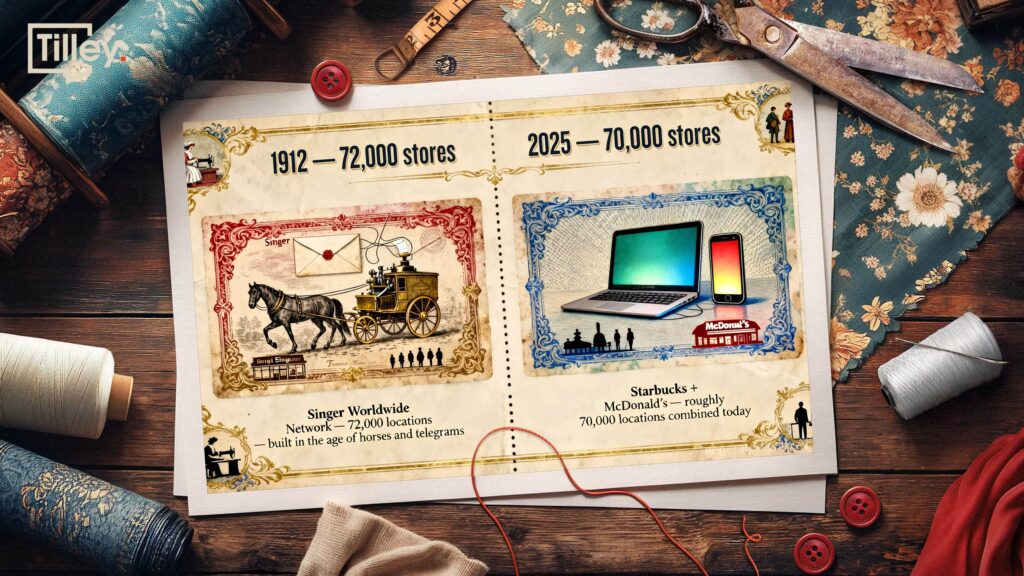
- 1912 – over 72,000 retail points worldwide
Compare these numbers with the Starbucks and McDonald’s networks – they have roughly 70,000 locations combined today. Singer did it in times of horses and telegrams, and it was probably the most visible retail brand in the world at that time.
These stores didn’t only sell, but they were also experience centers, the direct ancestors of Apple Stores or Tesla Showrooms. Women could come in, sit down, try the machines, get free sewing lessons, and even enjoy tea all without any pressure to buy. It was a masterclass in customer education, pre-sale value, and brand immersion. By the time a customer was leaving the store, they were leaving with a firm thought that they needed that machine.
Which created yet another and final bottleneck that Singer had to solve. A needle made in Germany had to fit perfectly into a machine assembled in Brazil, with a pedal cast in Canada. Absolute interchangeability across continents.
Innovation 7: Global Supply Chain
The company had grown too large, too diverse, and too geographically spread out to operate under a centralized structure that was common at the time, yet it couldn’t afford to be spread into multiple smaller firms that would operate independently. They needed something that would allow them to stay consistent in their product for their consumers, while being operationally independent and manageable.
To put things in perspective, by 1905, Singer was the 7th largest company on Earth by market value. And for a few weeks in 1912, Singer was worth more than the whole US Steel industry. A sewing machine company briefly became the most valuable enterprise in America. By 1914, they were running major factories in six countries and selling in an estimated 140 countries. Harvard Business School now recognizes Singer as one of the world’s first true multinational corporations. So how do you manage an organization that big?
To manage this all, Singer invented an early version of the multi-divisional or M-form structure. M stands simply for multi-division. This is the blueprint every global conglomerate uses today.
Now, what is M-form? Imagine you have one big school, but the classrooms are all over the world. Each classroom can choose how it teaches, because kids in different places learn differently. But the principal still sets the rules, checks the homework, and makes sure everyone reports their results in the same way. Freedom locally, control centrally. That’s the M-form.
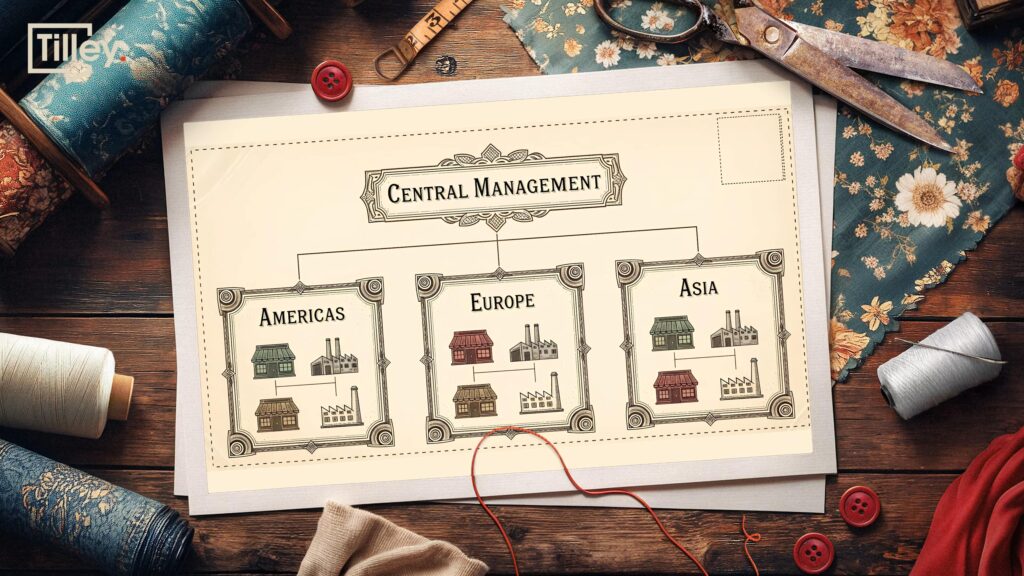
All operations were autonomous. Local managers in Brazil, India, or France had the freedom to adapt sales, marketing, and distribution to local customs and languages. They could tweak pricing, adjust local credit plans, and hire the right people for their market. This flexibility let Singer thrive in culturally diverse markets.
At the same time, headquarters kept full control. Weekly telegrams reported sales, costs, and inventory in a standardized format. It was the first version of a global KPI dashboard.
This combination – local autonomy with central control – became the template for Coca-Cola, Nestlé, General Motors, and nearly every major global corporation that followed. Singer didn’t just sell sewing machines. It built the architecture of the modern multinational corporations.
So next time you…
- …pay in installments for a phone,
- …walk into a beautiful, standardized brand store,
- …see a perfect, scripted sales demo,
- …or benefit from a company pension plan…
…remember you are using an idea born in a Singer over a century ago. Which makes me wonder: do you have any memories from childhood of those machines? Share them in the comments below.
On that note, thanks for reading this deep dive. If you enjoyed it, don’t be shy – share it with your friends. And if you’d like more stories like this, stay tuned. There is more on the way!