
If you are reading this article, you are probably trying to decide whether your business development team needs a CRM. Maybe you already bought one and it sits half used. Maybe you are still deciding. Either way, there is one thing almost nobody tells you before you buy: in business development, a CRM is not for every team, and the software is rarely the reason it fails.
For every CRM rollout that succeeds, two or more fail. That is not a guess, it is a pattern researchers have tracked for two decades. And it is almost never the CRM’s fault. The company was not ready, there was no structure in place, and the software got bought to fix everything on its own.
So before you shortlist a single platform, there are two questions worth answering honestly: is your market even big enough for business development to work, and is your team built to run it. Get those two answers right and the tool question gets simple.
Is this article for you?
This article is for companies doing, or building, business development on top of an existing product and customer base. That covers a range of teams:
- Companies adding a new line of business or a new customer segment on top of what they already sell.
- Teams that sell business to business, where the buyer pool is a defined list of companies rather than a mass consumer market.
- Any team that already splits, or is close to splitting, prospecting, closing and account management into separate jobs.
- Founders and sales leaders trying to work out if a CRM is worth the licence fee at their current size.
When this article is not for you
If you sell to consumers, this is not your article. In consumer markets you can run ads on Facebook or TikTok, reach a million people, and pull buyers out of that pool. None of the logic below applies to you.
It also is not for you if your entire addressable market is a handful of companies. If you could name every buyer in your market on one page, business development in the classic sense is not your game, and neither is a CRM.
Why business development is a different sales motion
Business development means finding new customers and building a new revenue line on top of a company you already run. You are not starting from zero. You already have a product, a team and paying customers. The job is adding one more stream of customers on top of what already exists.
Ninety nine percent of the time, this is a B2B motion, not B2C, and the reason is simple. In consumer markets your target is a million anonymous people, and paid ads find them for you. In B2B your target market might be five thousand companies worldwide. Filter by country and by price segment and you are down to five hundred you can actually sell to. You cannot run ads at five hundred companies. That is exactly why business development exists as its own discipline, built on outreach, not advertising.
The five-person market test
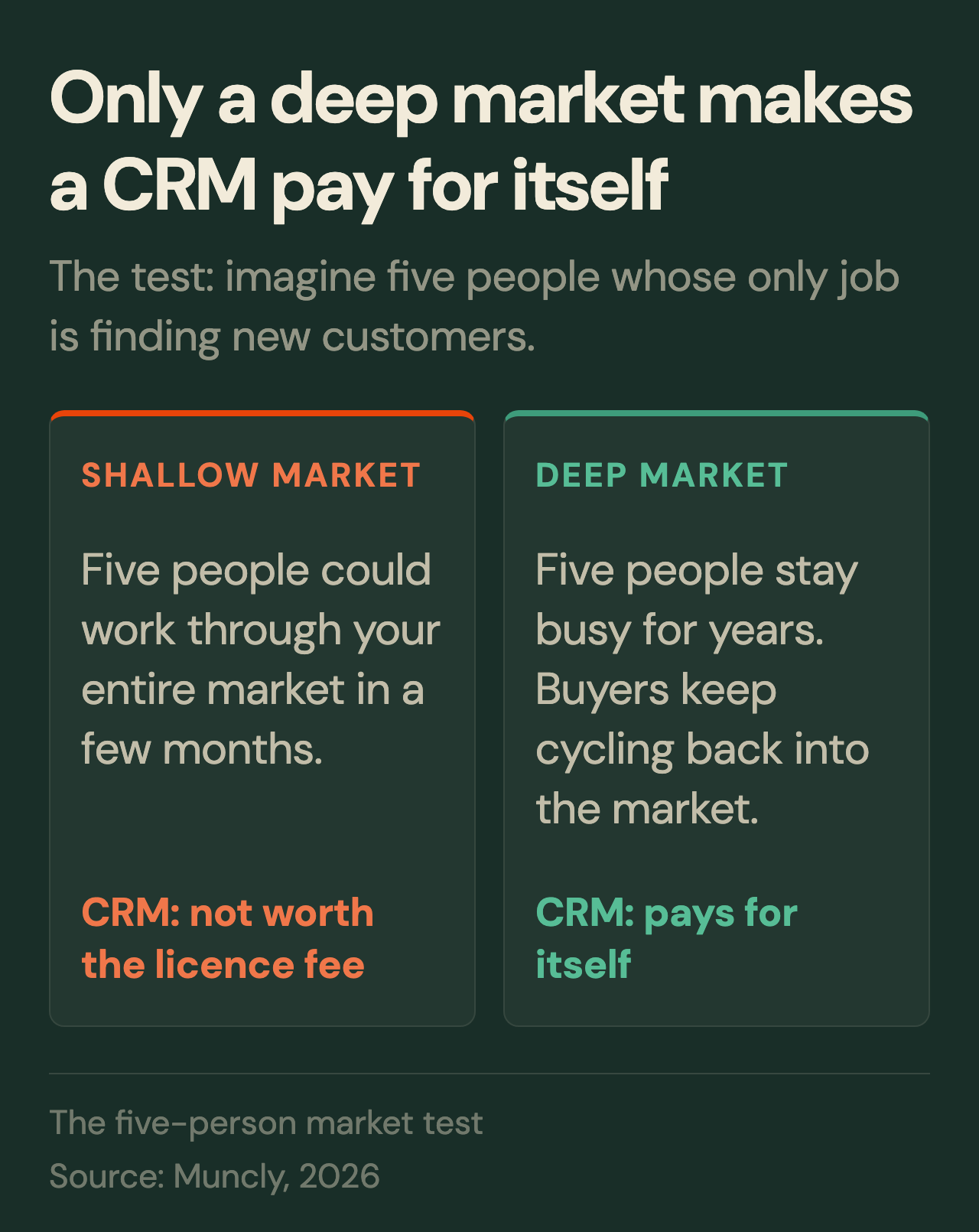
Here is a simple way to check whether business development, and a CRM, are even the right model for you. Imagine you hired five people whose only job is finding new customers.
If those five people could work through your entire market in a few months, business development in the classic sense is not for you, and neither is a CRM. Your market is too shallow. A CRM will give you convenience and visibility, but not the kind of return that justifies the licence fee.
If instead that same pool of buyers would keep five people busy for years without running dry, and customers keep cycling back into the market over time, you have a real pipeline to build. That is where a CRM starts to pay for itself.
The one-person trap
There is a second test, and it catches almost as many companies as the first. If one person is handling everything, prospecting, selling and servicing every account, you cannot hold that person to a new-customer target. Every day they are juggling competing priorities. Given a choice between a repeat customer’s email and a fresh lead from the website, they answer the repeat customer, every time. The lead waits.
If you recognize your business in that description, a CRM is not going to fix it. Until you split the work across at least two people, a CRM is at best an expensive address book.
The four roles a CRM actually connects
Once you have a market deep enough and more than one person working it, business development runs on a fairly consistent set of roles, no matter the industry.
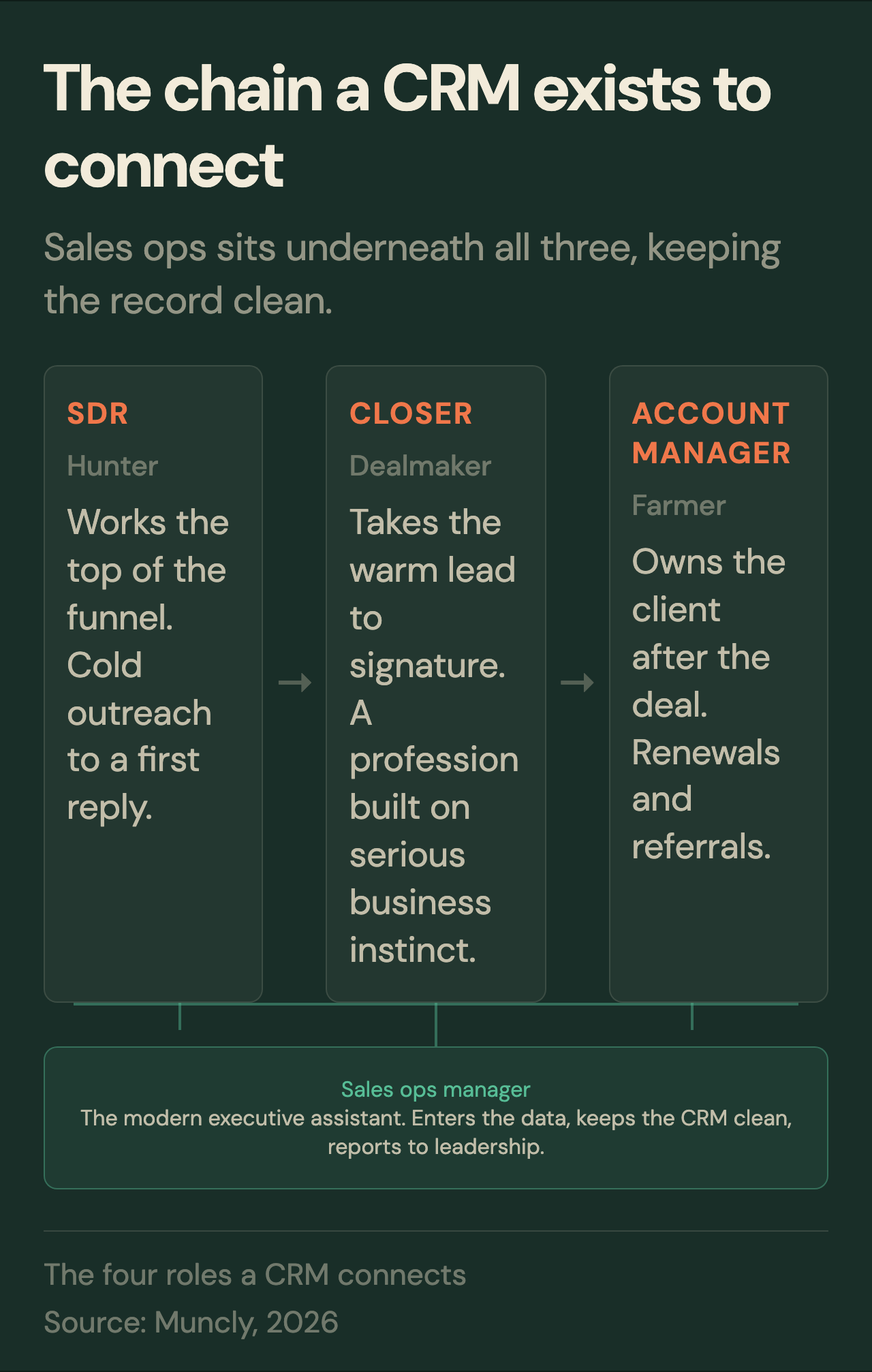
The SDR, short for sales or business development representative, works the top of the funnel. They are out there mostly on LinkedIn, hunting down the right companies and getting them to a first reply and an initial qualification. It is usually a junior or mid level hire, and it may be the hardest seat in the business. Cold outreach means ninety eight rejections out of a hundred calls. Most SDRs either leave sales entirely or, rarely, become closers. Out of a thousand SDRs, maybe one or two make that jump.
The closer takes a warm lead all the way to signature. This is worth understanding clearly: closing is its own profession, not the next rung up from hunting. A good closer has serious business instincts and can carry a deal to the finish line without losing it. The trade off is that closers are some of the least systematic people you will meet. They will chase down a customer relentlessly and ignore any internal rule or boundary along the way. That is not a flaw to fix, it is the price of someone who actually brings in the money.
The account manager, sometimes called the farmer, owns the client once the first deal closes. Repeat business, referrals and renewals live or die with this role.
And underneath all three sits the sales operations manager. Closers, in particular, are the wrong people to manage their own admin. Someone has to enter the data, update the deals, keep the CRM clean and put together reports for leadership. Think of it as the modern version of an executive assistant, built specifically to support a closer’s work, with real business context rather than just calendar management.
The handoff is where a CRM actually earns its keep
Here is where the real risk shows up. A lead passes from the SDR to the closer, and from the closer to the account manager. Without a CRM, you will lose contacts at that handoff, guaranteed. The lead lives in an inbox and a memory. The closer is in a meeting, already forgetting a callback they promised. Nobody can say for certain what happened, or when.
A CRM fixes this with a record. The SDR’s job now includes logging the handoff. The closer’s record shows the company, the date and the next step. If two days pass with no follow-up, it shows up in plain sight, and you can reassign the lead or make the call yourself. That is what accountability actually means here. You can only hold someone to an action you can prove took place. (If your team already has a CRM and still will not touch it, that is a separate problem worth its own read: why salespeople refuse to use a CRM, and how to fix it.)
Why software alone will not fix any of this
It is tempting to think that since the handoff is such an obvious pain point, buying a good CRM sorts itself out. It is closer to the opposite. If your business has no split between SDR, closer and account manager, and no plan to build one, a CRM will not help you. Software does not create a process, it supports one you already run. Buying a system for a business with no structure is a great steering wheel bolted to a car with no engine. It looks right and goes nowhere.
We are watching the exact same pattern play out with AI right now. A widely cited MIT study found that ninety five percent of enterprise AI pilots show no measurable financial return, despite thirty to forty billion dollars poured into these projects. The root cause is identical to CRM failure. People expect to type one line into a chat window and get results, without building any process around the tool. AI does not replace a sales structure you never built, and neither does a CRM.
Which platform actually fits
Once the structure is real, the tool question gets simple, and I will say up front that I am a Salesforce consultant, so take this with that in mind. Not because anyone pays me to push it. If anything it is the opposite, I pay for certifications and conference tickets to keep working on the platform.
Salesforce is close to the only real option for the closing and account management side of this job. Every business runs on a genuinely unique combination of processes, and Salesforce configures to almost any of them with little or no code. It is not the most polished platform on the market, parts of it are dated, but it became the industry standard because it solved what businesses actually need: a flexible database with solid reporting, not the prettiest interface. That flexibility is what cuts your project risk. When you bring Salesforce a requirement, the answer is almost always “we can build this,” even before anyone knows exactly how.
Where Salesforce is genuinely weak is active outreach. Its built-in tools are made for inbound flow and call centers, not cold prospecting. For the SDR stage, pair it with a dedicated outreach tool instead, integrated with the CRM. Every order, message and interaction from closing onward should still land in Salesforce, so you decide based on numbers rather than gut feel.
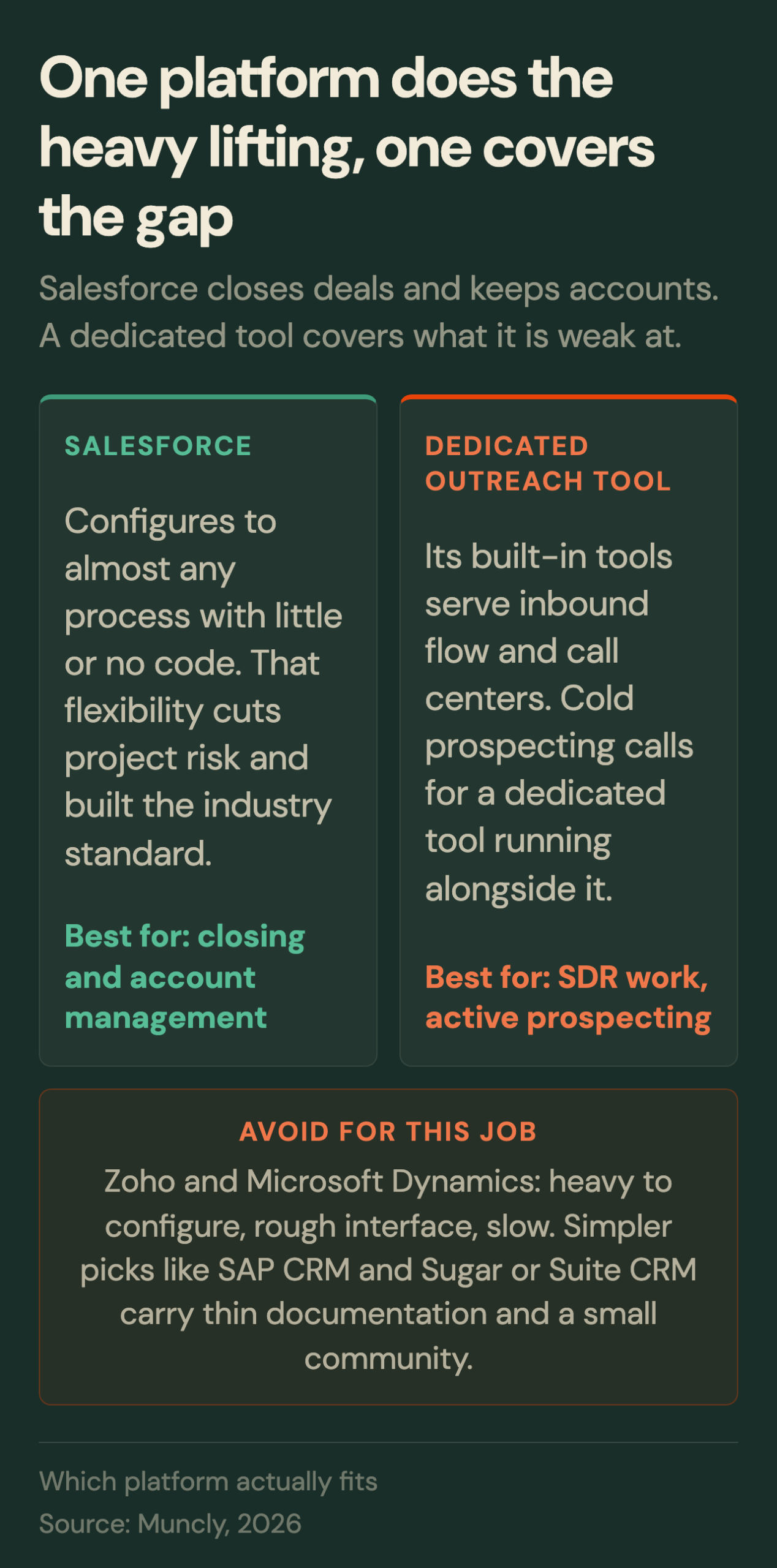
I do not recommend Zoho or Microsoft Dynamics for this. Dynamics is needlessly complicated to configure, the interface is rough and it is slow, though some banks like it for on-premise deployment. Zoho, SAP CRM, Sugar CRM and its open source cousin Suite CRM are simpler and more limited, and every one of them shares the same problem: a small community and thin documentation, so when you hit something non-standard there is little help waiting for you.
One more thing worth saying plainly. Be careful with the big consulting firms on this kind of rollout. Too often a company says “we need a CRM,” and the firm staffs five or six consultants who need to justify being on the project. Nobody checks whether you actually needed the rollout, or needed it at that scale. It is the exact same structural failure this article opened with, just sitting on the vendor’s side of the table.
What this article does not cover
A few things are out of scope on purpose.
- Step by step Salesforce configuration for a business development team.
- Which specific outreach tool to pair with your CRM. There are not many good ones, and it is worth a short search of its own.
- Compensation and quota design for SDRs, closers and account managers.
- Consumer facing sales motions. If you sell B2C, this article was never for you.
Each of these deserves its own piece.
What to do this week
Before you talk to a single vendor, run the two tests above on paper.
First, the market test. Picture five people whose only job is finding customers. Would they drain your market in months, or keep busy for years while buyers cycle back. Write down which one is true.
Second, the structure test. Name who owns each part of your pipeline today: who prospects, who closes, who keeps the account after that. If it is one person wearing all three hats, that is what needs fixing first, not the software.
Once those two pages exist, the CRM decision gets much simpler, and Salesforce is the right starting point for most teams that clear both tests.
If you want the two page version of everything above, we put together a free cheat sheet that walks through both tests and the tool pick in a single sitting. You will find the link in this article and in the sidebar.
And if you want a faster, more specific answer, come talk to us for a free CRM audit. We map how your team actually finds, sells to and keeps customers, then tell you plainly whether you need a CRM at all, which one fits, and what to fix first. Book it here: https://munc.ly/b2b-crm