
If you are a startup and you are looking for a CRM, I have some bad news for you. A system built specifically for your business almost certainly does not exist.
And that is not because you have not searched hard enough. It is because being a startup usually means having a non-standard business model, a non-standard product, or both. Ready-made CRMs tend to exist only in industries where thousands of companies already work in roughly the same way.
Here is what that looks like in practice. Take a car dealership. It is a conventional business that the software market understands very well. A dealership looking for a CRM can find five or six systems built specifically for auto dealers. A vendor asks a couple of questions: Do you take trade-ins? Do you offer leasing? They check the right boxes, configure the system, and the dealership can have something working within a week.
A startup rarely gets that. A few point tools might cover parts of what you need, but they rarely add up to one system that actually works together. But that does not mean there is no platform for you. It means you are not choosing a ready-made industry package off the shelf. You are choosing a platform you can shape around your business as it changes.
And that is what this article is about. Today, we are going to talk about when a startup actually needs a CRM, what you should look for when choosing one, and three platforms that I believe actually hold up in practice.
Before we get into platforms though, let us be honest about who actually needs to keep reading, because not every startup is at the point where this decision even matters yet.
Is this article for you?
This article is for startups that are, or are close to being:
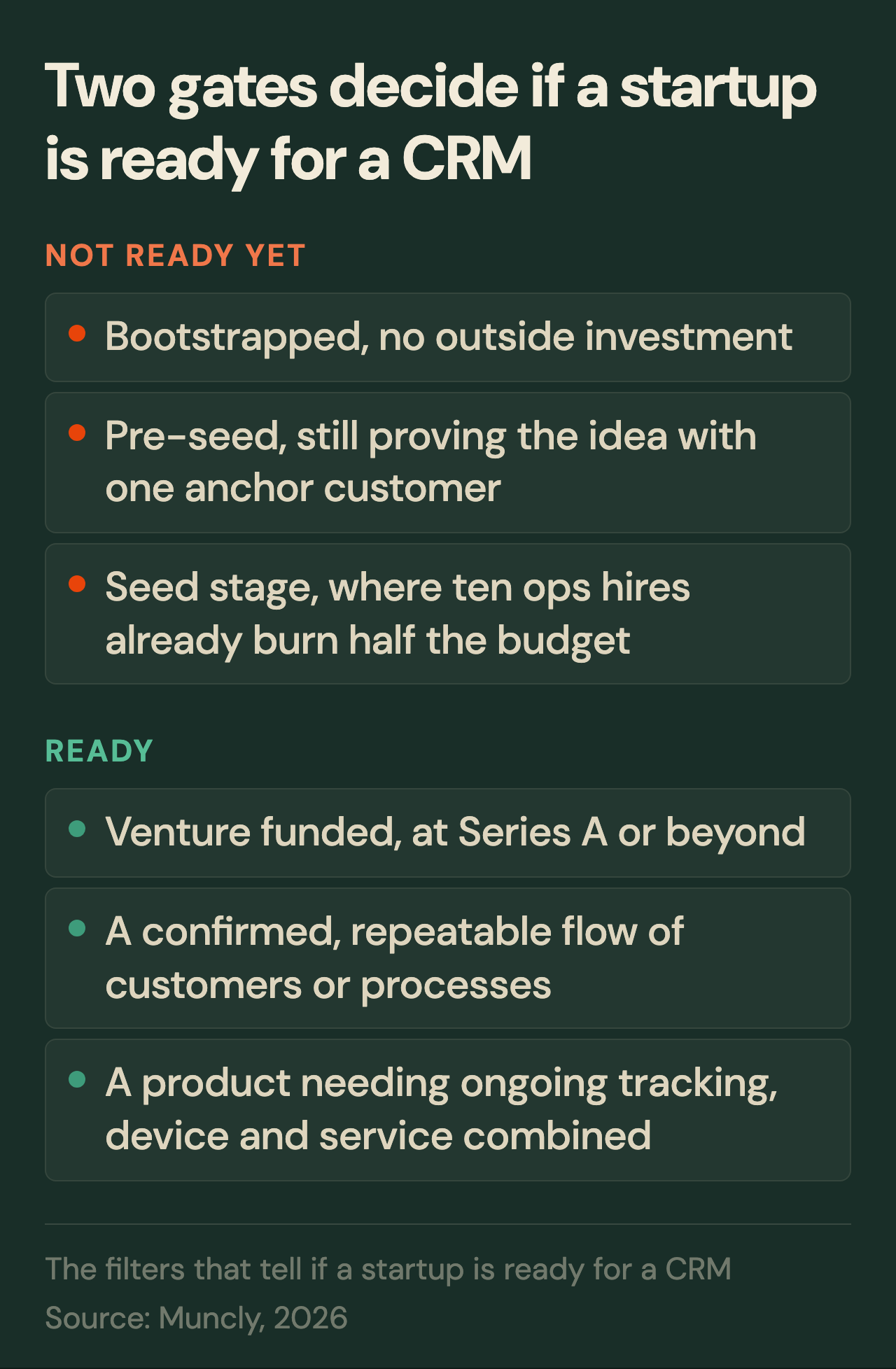
- Funded by venture money, not bootstrapped on founder savings alone.
- At Series A or beyond, with a confirmed, repeatable flow of customers or processes running at volume.
- Building a product that needs ongoing tracking, something that sits between a physical device and a service, where you have to both support the customer and watch how they actually use what you sold them.
When this article is not for you
Now for the flip side, because ruling yourself out early saves you more time than reading on. If you are bootstrapped, running on your own money with no outside investment, stop reading here. Everything below assumes some capital to spend, and a bootstrapped business rarely has room for it yet.
Pre-seed is also not the moment. At pre-seed you do not have a working company yet in any formal sense. What you need is one anchor customer to prove the idea holds up at all, and no CRM changes that outcome.
Seed is closer, but run the numbers before you convince yourself it is time. Here is how that math actually plays out. Say you are in Europe and an operations hire costs you forty thousand euros a year. Ten of those people already burn half a million. Twenty is your entire annual budget. At that size you have neither the revenue nor the spare cash to bolt anything on top of the core team, which is exactly why the real conversation about a CRM does not start until Series A, once you have a confirmed pipeline of customers or repeatable work to run through it. (If any of this sounds like your stage, here is a longer look at when a CRM is not worth it yet.)
The product test
So far we have only talked about money and timing. Stage is only half the filter. The other half is the product itself. It needs to require ongoing tracking, something that sits at the intersection of a device and a service, where you are both supporting the customer and watching how they use what they bought.
Here is how that looks in practice. We once worked with a startup that made custom hearing aids, a physical device paired with a service wrapped around it, constant telemetry, constant adjustment. I cannot name the company, that one is under NDA, but the point stands: a CRM there was not a nice-to-have, it was the only way to hold in your head what was happening with every single customer.
If your situation is close to this, venture money, Series A or past it, and a product that needs watching, keep reading, this article is for you.
Why there is no off-the-shelf option
So say you clear both gates. Money, stage, a product worth tracking. You would think the search gets easier from here, but it does not, for a specific reason. If you reduce the whole problem to one word, it is customization. A conventional business has a model the entire market already understands, so ready-made templates exist, built out of thousands of identical rollouts. A startup, by definition, has an unusual business model, an unusual product, or both, a story that always differs somewhat from whatever already exists on the market. That is exactly why industry-specific CRMs never fit you, and it is also exactly why the next idea feels so tempting.
Do not build your own CRM
Once founders accept that no off-the-shelf system fits, most reach the same conclusion: build one. But it is one of the most expensive mistakes you can make, and the reason is not the price tag or the timeline.
Every line of code you write today becomes your responsibility tomorrow. Someone has to maintain it, test it, patch it, secure it, keep it moving forward, all while your actual product still needs building. At some point you notice you are running two products instead of one. The first is what you sell to customers. The second is the CRM you are stuck maintaining just so your own team can use it.
The fix is not building everything yourself, it is finding a platform that already covers the standard parts of your business like customer records, deals, documents, automations, reporting, and building only the piece that actually makes your company different.
Here is what that looks like when a company gets it right. One of our clients, a startup called Sender, is close to Uber for freight, push a button and a truck shows up. Their matching engine, the algorithm that pairs cargo with trucks, is the part that makes them unique, and they built that themselves, correctly. But everything client-facing, bidding on tenders, invoicing, support tickets, runs on plain Salesforce, because none of that is unique to them. Tenders, invoices and support tickets work the same way at every company, and there is no reason to reinvent them.
So, build what makes you different. Buy everything else.
Start simple, not standard
Now say you have found the right platform and skipped the build-it-yourself trap. There is still one more way to get this wrong, and it catches almost everyone. Say you clear every filter above, venture money, Series A, a product worth tracking. It is tempting to think the job now is picking a good platform, configuring it properly, and running the business “like adults” from day one.
That instinct is exactly where most startups make their most expensive mistake. They roll out a full corporate-grade system, rigid processes, heavy automation, dozens of required fields, before the business itself has actually settled into a shape. A Coherence survey found that sixty four percent of early-stage startups that adopt a CRM in their first year end up abandoning it or switching to something else within eighteen months. The pattern is not the platform failing, it is the business trying to encode a sales process that does not exist yet.
For contrast, here is what it looks like when a startup gets the timing right. Look at what Cotera did instead. Twelve people, still pre-Series A, and rather than reach for an expensive system, they ran fourteen months on HubSpot’s free tier. In that time their pipeline grew from four hundred thousand dollars to one point six million in annual revenue, without paying a cent for the CRM itself. A system that costs nothing, matched to the right size business at the right moment, outperformed plenty of expensive rollouts.
The lesson here is not to avoid a CRM, or automation. It is to avoid locking in a rigid process on day one. As a startup, your sales stages will change five or six times in the first year alone, because you do not yet fully know how to sell your own product. Keep the system close to a notebook: one pipeline, three fields, comments, tasks, nothing stacked on top. Someone still needs to own it though. Appoint a sales operations person, someone who can configure the basics themselves or work well with whoever does, keep the data clean, and help the rest of the team log what belongs in it. (Here is more on why that role matters even at this size.)
Which platform actually fits
Now that we have covered the how, let us get to the question you actually came here for: which CRM should you choose? Cut the dozens of niche CRMs and you are left with three platforms that can actually hold a non-standard process.
Twenty
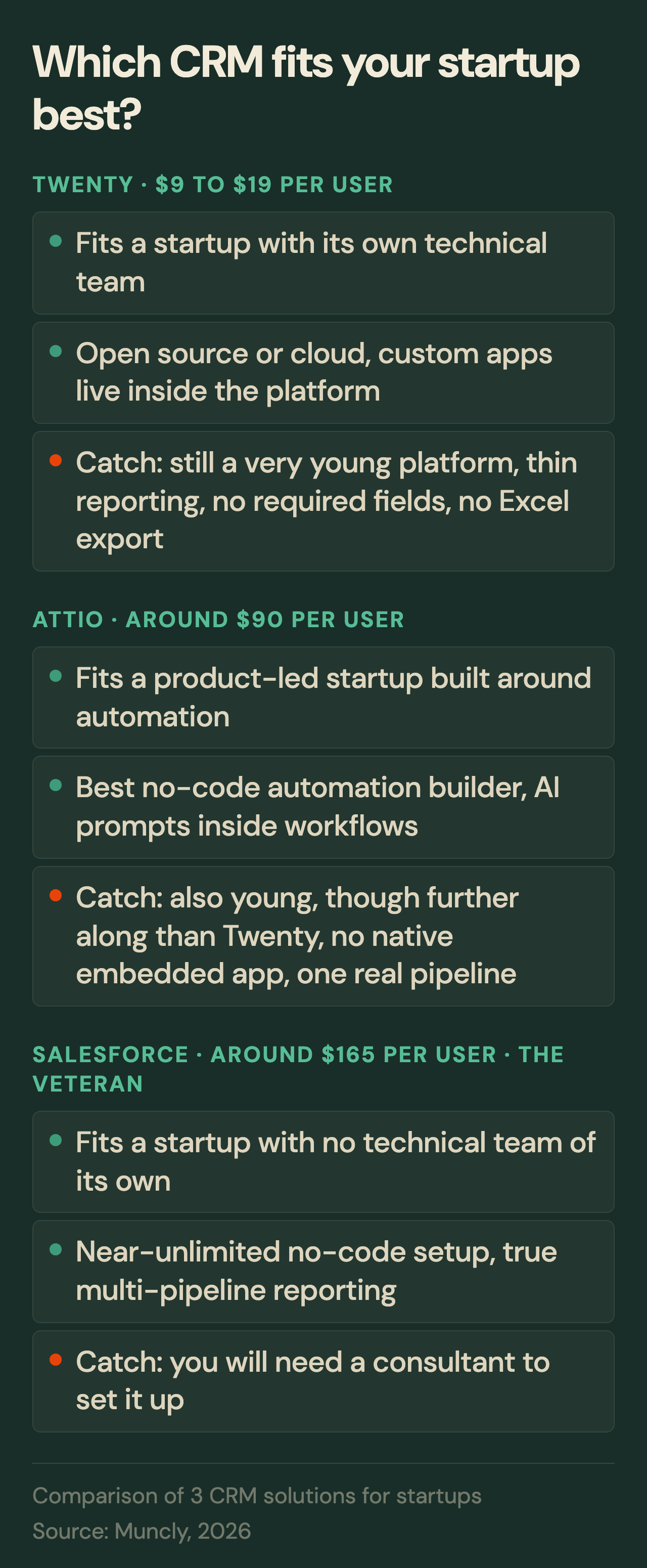
Twenty is the one worth knowing about, mostly because almost nobody talks about it. And when it comes to price versus capability, it might be the cheapest real CRM I know.
You can self-host the open-source version or pay for the cloud plan. Personally, I would skip the open-source route entirely. If something breaks and you are not paying, nobody owes you an answer.
The paid plans start at nine dollars per user per month for the base tier and nineteen dollars for the more advanced one. Either way, you get a genuinely capable CRM for the price.
Here is what that looks like in practice. I recently built a custom project on Twenty myself that included invoicing, time tracking, and reshaped lead, contact, company, and deal cards. I never hit a wall the platform could not handle. You can even build custom apps inside Twenty itself, with no separate hosting required.
The tradeoffs are real, though. There is no required-field validation, no clear indicator of where a deal sits in the pipeline, only basic dashboards instead of proper reporting, and no export to Excel.
Twenty makes the most sense for teams with their own technical people who can take advantage of its flexibility and live with the rough edges of a young platform.
Attio
Attio covers exactly what Twenty lacks. It is a more mature, polished platform built for tech companies, with automation as the actual core of the product, AI included.
At around ninety dollars a user, you get what is probably the best visual automation builder on the market, find an event, attach an action, no code involved, and you can drop full prompts and behavior scenarios into those automations rather than simple rules. For example, a customer hits a trigger, an email goes out automatically, no engineering required. The built-in chat is strong too.
The main weak point here is interface customization. You can add custom blocks and tabs, but you cannot build a fully native app that lives inside the platform. That has to sit outside Attio and connect to it. There is also no true multiple-pipeline support, only lists as a workaround.
What you get in exchange is a platform meaningfully further along toward production than Twenty, with a bigger, more vetted partner network. Attio fits product-led tech startups where automation is the core of the process and you do not need to embed your own app natively.
Salesforce
Salesforce covers what neither of the other two can. It makes the most sense for teams that want a mature, highly flexible platform and would rather rely on an established ecosystem of specialists than build and maintain everything themselves.
It is the veteran here, running around one hundred sixty to one hundred seventy dollars per user. That is meaningfully more than the other two, but in exchange, the flexibility is close to unlimited.
You can configure almost any process with no code at all. Salesforce is also backed by a massive ecosystem of consultants who have worked with it for years, so if you have an unusual request, chances are someone has solved something similar before.
It is also the only one of the three that properly handles several pipelines at once. You can have different deal types with different fields and stages, then roll everything up into one report using shared numbers like amount and close date.
The tradeoffs come from its age. The database was not built for very high write frequency, so if you tried piping something like a live stream of payment events directly into it the standard way, you could hit platform limits very quickly at high enough volumes.
There are separate ways to handle that kind of streaming volume without storing every event directly in Salesforce, but you need to know those options exist. And to be fair, most startups will never come close to that ceiling anyway.
Implementation is another consideration. Salesforce is a huge platform with dozens of APIs and years of functionality built into it. You can learn the basics yourself, but getting the most out of it usually means working with someone who knows the platform well.
So choose your implementation partner carefully. There are good offshore teams out there too, but I would look closely at their Salesforce experience, communication, and track record before making a decision. In many cases, a small or mid-size consultancy in Europe or another established market can be the safer choice.
To sum up
Put plainly: if you have a strong technical team and want maximum flexibility for minimum spend, go with Twenty. Just accept that you will be building a lot of it yourself around a still-young platform.
If you are a product-led tech startup where automation drives the whole process and you do not need a native embedded app, go with Attio.
If you do not have a technical team of your own, or you need a mature system you can rely on, go with Salesforce. And when in doubt, Salesforce is the safe pick.
What to do this week
Before you book a single demo, run your business through the two filters above, on paper.
First, stage and funding. Are you venture-backed and at Series A or beyond, with a confirmed flow of customers or work to manage at volume? If not, wait.
Second, the product test. Does what you sell require ongoing tracking, something that sits somewhere between a product and a service? If both are true, choose your platform based on the technical-team question above and start simple. One pipeline, three fields. Nothing more until you actually need it.
And if you still do not know whether you need a CRM, come talk to us for a free CRM audit. We will look at where your business actually stands and tell you plainly whether you are ready, which platform fits, and what you should fix first.
Book your free CRM audit here: https://munc.ly/startup-crm