
Have you ever thought about what your business processes will look like in three, five, or maybe even ten years, when AI is everywhere? If you haven’t, now is a good time to start.
Right now, more and more companies are rolling out AI. They’re using large language models every day, and launching AI agents that automate different kinds of business processes. And I think this is only the beginning.
According to one of Deloitte’s studies from 2026, 74% of business leaders expect major changes over the next 4 years. They believe almost half of all business processes will either be rebuilt or created from scratch around AI agents. And 61% expect most of those agents to work almost entirely on their own, with people mainly checking the results.
Now, with numbers like that, you might ask: Is the future of AI in business really just agents that answer customers, work with data, and slowly take over more and more of the day-to-day work inside a company?
I’m a little skeptical about that. And that’s why I decided to write this article and talk about what I think the next stage of AI in business is going to look like.
AI agents are only the beginning
Before we get into the main idea of this article, I want to make one thing clear. I’m not saying AI agents don’t have a future. Quite the opposite. Businesses are already using them, and their role is only going to grow.
And I’m not pulling that out of thin air. There are real forecasts behind it. For example, Gartner predicts that by 2028, the standard setup for a CRM could be one where AI does most of the work with customers, and a human steps in only for the tricky situations. I can absolutely see that happening.
What’s more, I already use AI agents in my own business, and I help other companies set them up. But I think agents are only a small part of where all of this is going. To me, the much bigger opportunity for businesses is using AI to build their own tools and custom applications for very specific needs.
Disposable software is a second kind of software
Sounds a bit strange, right? We’re used to thinking that building your own custom app always costs more than buying something ready-made.
For years, most companies stayed out of custom development. They stuck with what’s called product software. We bought CRMs, ERP systems, accounting programs, and dozens of other ready-made tools, and we still do. Those systems are proven, stable, and reliable, and whole teams work on them all the time.
And that makes sense. Why build your own CRM from scratch, and burn a huge amount of money and internal resources when you can simply buy one that already exists?
But AI is starting to change that logic. We’re beginning to see a type of software appear that barely existed before. Let’s call it disposable software.
Basically, these are small applications you build for one specific task, use for as long as you need them, and then simply get rid of them. You could also call them micro-tools, because each one solves one small, very specific problem.
Now, you might be thinking, what’s actually new about that? We could build small custom applications before AI. And you’d be right. Of course you could. But there was one big catch. The price.
In the past, building a small custom tool could cost almost as much as building a real software product. Then AI came along and changed everything. Today, you can build a custom application for one very specific task for next to nothing, sometimes in just a few days.
Let’s take a simple example.
Imagine a merchandiser, someone who visits stores and checks how products are displayed on the shelves. Let’s say he wants an app that shows all the stores he needs to visit that week.
A few years ago, he would have needed a decent budget, a developer, a lot of back-and-forth explaining exactly what he wanted, and then he would just have to hope the final result matched what he had in mind.
Today, the process can look completely different. That same merchandiser could buy a Claude subscription, explain in plain language what kind of application he needs, and within a few days build a working tool for that one specific task.
That’s a pretty specific example from one industry, but I’m sure the same logic can be applied to almost any business.
Where AI can help your business right now
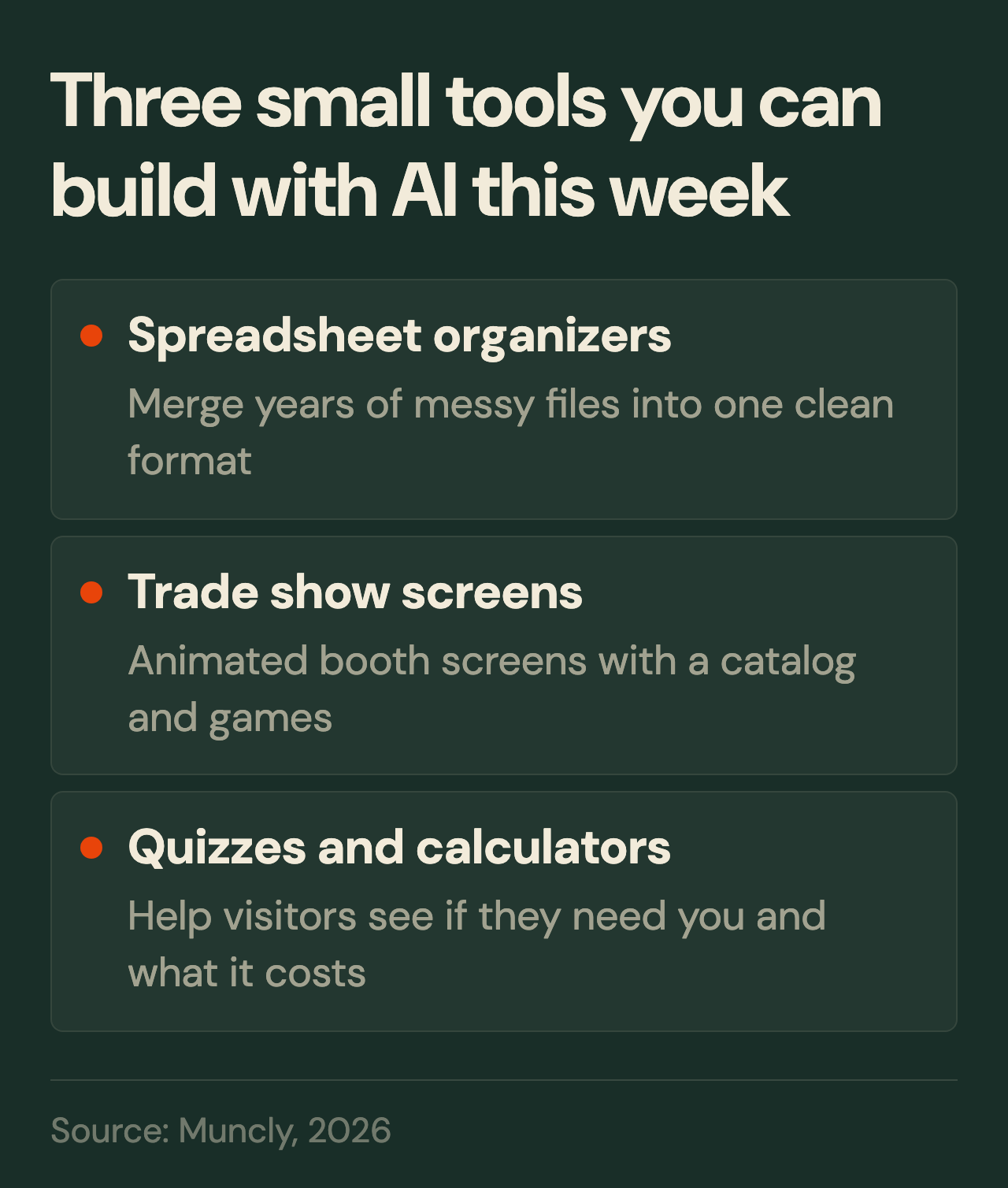
If you look a little closer at how your business works, you can probably find at least 3 places where AI could be useful and a small custom tool could make your life easier.
Clean up your spreadsheets
The first way you can use AI in your business is to clean up your spreadsheets.
I’m almost 100% sure your company has a bunch of Excel files or Google Sheets that were created at different times, by different people, and probably using completely different rules.
Now imagine you need to pull the order history for the last ten years into one file. But there’s a problem. In one file, an order takes up one row. In another, it’s split across several rows, or even several tabs. Some files use one date format, others use another, and in some places, part of the information was simply copied straight from an email. Roughly speaking, your spreadsheets are a total mess.
If you try to merge all that by hand, you’ll get lost very fast. And that’s the moment AI can step in. You could build a small tool specifically for this task. It could go through your files, understand how they’re structured, pull out the information you need, and bring everything into one consistent format. Sounds pretty cool, right?
Prepare for trade shows
But spreadsheets are far from the only use case. Another way you can use AI in your business is when you’re preparing for exhibitions or trade shows.
If you’ve ever been to a trade show, you know every company is trying to stand out at its booth. Some hang a nicer banner. Some hand out souvenirs. And some want something more high-tech, like an animated screen.
But just a few years ago, building an animated screen meant hiring developers and setting aside a big budget. Today, you can do the same thing with AI at a fraction of the cost and in just a few days.
I know, it sounds too good to be true. But this is already happening. And I think this is exactly the kind of thing that can give your company a real edge.
Let me show you a real example from our own work.
Last year, we helped one of our clients get ready for a trade show in Osaka. The task was pretty straightforward. The client wanted an interactive booth, and we helped him build it.
The idea was to create an animated screen that would welcome visitors, show the product catalog, and add some gamification. In 4 days, we had a working prototype that already covered around 80% of the task. We spent another 4 or 5 days improving it. So, in just over a week, we had a finished tool the client could actually use at the exhibition.
And then the most interesting part happened. At the show, the client was talking to people from other companies and walking around looking at their booths. One of those booths caught his attention because its functionality was very similar to what we had built.
The client got curious how long it took to build. So he walked up to that company’s representative and asked. It turned out the company had hired a separate team, and the development took about six months.
Just imagine what that booth must have cost if a whole team spent six months building it.
Build your own quizzes and calculators
Now, let’s keep going, because AI can do a lot more than just help you create trade show booths. The next use case is building your own quizzes, calculators, and other interactive tools for your business.
In the past, if you wanted to build something like that, you would’ve had to either hire a developer or find some kind of paid builder designed for that type of task. Now you can just do it yourself with AI. And I’m speaking from experience here, because we’ve already done this at Muncly.
We’re big fans of quizzes. We used to build them with separate paid services, but we always kept running into limits on what they could do, or a subscription price that kept climbing.
Then one day, we decided to try building our own quiz with AI. We settled on a quiz that would help a person figure out whether they need a CRM system at all.
We explained to the AI what we wanted to build and gave it a large amount of our own data, including old project estimates, documentation from previous projects, and other information we’d collected over the years.
Next, we asked it to work out what we usually estimate, what criteria we look at, and in what volumes. Then we asked it to use all of that to build the logic of the quiz and help us put it together.
In the end, AI built us a full quiz. We embedded it right into our website, and it works great. If you’d like to see what it looks like, you can take the quiz here and find out whether your company needs a CRM.
Besides that quiz, we also built a calculator that helps you roughly estimate how much a CRM implementation could cost. You can try the CRM implementation cost estimator here.
We’ve got a few more interactive tools planned, but let’s not get into that right now.
Instead, let’s get back to the main topic of this article and look at one more example of how AI can help you build a micro-tool for one specific task.
AI for personal tasks
This next example isn’t directly related to business, but it does a good job of showing just how broad the possibilities are when you’re using AI to build a tool for one very specific purpose.
Not long ago, one idea popped into my head. Why not build myself a custom fitness app?
I’ve been going to the gym for a long time. I have my own coach and a personal workout program mapped out a year ahead. Sounds great, but there’s one catch. That whole program lives in my chat with the coach, in a messaging app.
And let’s be honest, that’s not the most convenient place to keep a workout plan. Every time before the gym, I have to open the chat, scroll to find the right workout, and remember what I’m supposed to do today.
So one day I thought it would be so much easier to have my own fitness app. I took the idea to AI. I gave it my entire conversation with my trainer, explained what kind of application I wanted, and within a single day, I had working software.
Now I have my own app that guides me through every workout, shows each exercise in order, and tracks my rest time between sets.
And it’s already much more than just a list of workouts. I added a lot of little features. For example, I made the screen change color when my rest time is almost over, so even from a distance I can see that it’s time to get back to the equipment.
I also generated a picture for every exercise with AI. And for the movements I regularly mix up, I added short YouTube videos right inside the app. I’m planning to add some gamification too, like badges for finished workouts. But that’s something for the future.
The main thing is that I now have a complete, working piece of software that I built in a single day, and it cost me almost nothing.
As you can see, we’re living in a time of incredible opportunities. But there’s a catch.
The catch: the context window
Despite everything AI can do, we need to remember that it’s still an imperfect technology and it has quite a few limitations. One of the most important is the context window.
In simple terms, a context window is the amount of information AI can keep in its “head” at the same time while working on your task.
To make that easier to understand, think about human memory. Think about how much information you can keep in your head at once while working on one task, without looking back or scrolling through something you saw a minute ago. That’s your own context window.
AI works in roughly the same way. Of course, its context window can hold much more information than our memory can, but it’s still not unlimited. And that limitation plays a big role in how large and complex a disposable tool you’ll be able to build.
You can almost always build a simple app for one specific task. But when you’re building something really big and complex, sooner or later you’ll hit the limit of the context window.
That’s when AI may start losing track of the conversation, forgetting some of the things you discussed earlier, mixing up requirements, and at some point it may simply stop doing what you want it to do.
At this point, you might have an obvious question. Can AI still be used to build larger tools? I can confidently say yes. But this is where a lot depends on your technical knowledge.
If you’re technically skilled, understand architecture, know how to break a large task into smaller pieces, and can fix some code yourself when needed, you can go much further and use AI to build something large-scale.
But if you’re a complete beginner on the technical side, you’re probably not going to build a complicated app from scratch on your own.
Conclusion
But don’t get discouraged. Technology is developing incredibly fast, and there’s a good chance that in the future, some of the brightest minds in the AI industry will find a way to solve the context window problem.
For now, focus on what already works. Build micro-tools for your own specific tasks.
In case you’re not very comfortable with AI and don’t really know where to start, you can always reach out to our team. Book a free consultation, and we’ll go through your business processes and look at what can be automated with AI.