
If you run a distribution business and you’re currently researching what system you need, I’ve got something to tell you. And this isn’t going to be another “top five CRMs” article. We’re going to talk about how distribution actually works, and what it actually needs. Let’s get into it.
Who this article is for
Before we dive in, let’s get clear on who this article is for. First, it’s for anyone selling physical products B2B — and the word “products” matters here, because I’m not talking about projects or services. You buy a large batch from a manufacturer — clothing, office supplies, spare parts, whatever it happens to be — and you resell it downstream to retail stores or smaller wholesalers. That creates a three-link chain: supplier, you and a customer. And right in the middle of that chain sits your warehouse, which has to be managed.
That warehouse is where your biggest daily headache lives: purchasing. You collect orders from ten different customers for five different products from five different suppliers, and you have to pull all of that together and place consolidated purchase orders with those suppliers. If that’s the puzzle you’re solving every single day, that’s distribution.
Second, this article is for businesses that have grown past a million euros in annual revenue — ideally two and a half million — and that have at least two people in the same role. For example, two warehouse workers, two customer support reps, and so on. If you recognized your business in that description, this article is for you.
That said, this article isn’t for everyone. If you distribute specialized equipment that needs to be installed — say, kitchen equipment for new hotels — then on paper you’re a distributor, but in practice you’re an implementation partner, because your contracts include services, not just products. If that’s you, we’ll cover that kind of business separately another time. Today is about classic product distribution.
The two pillars of distribution
Now that we know who this article is for, let’s break down how distribution actually works, because the answer to “what CRM do I need” starts right here.
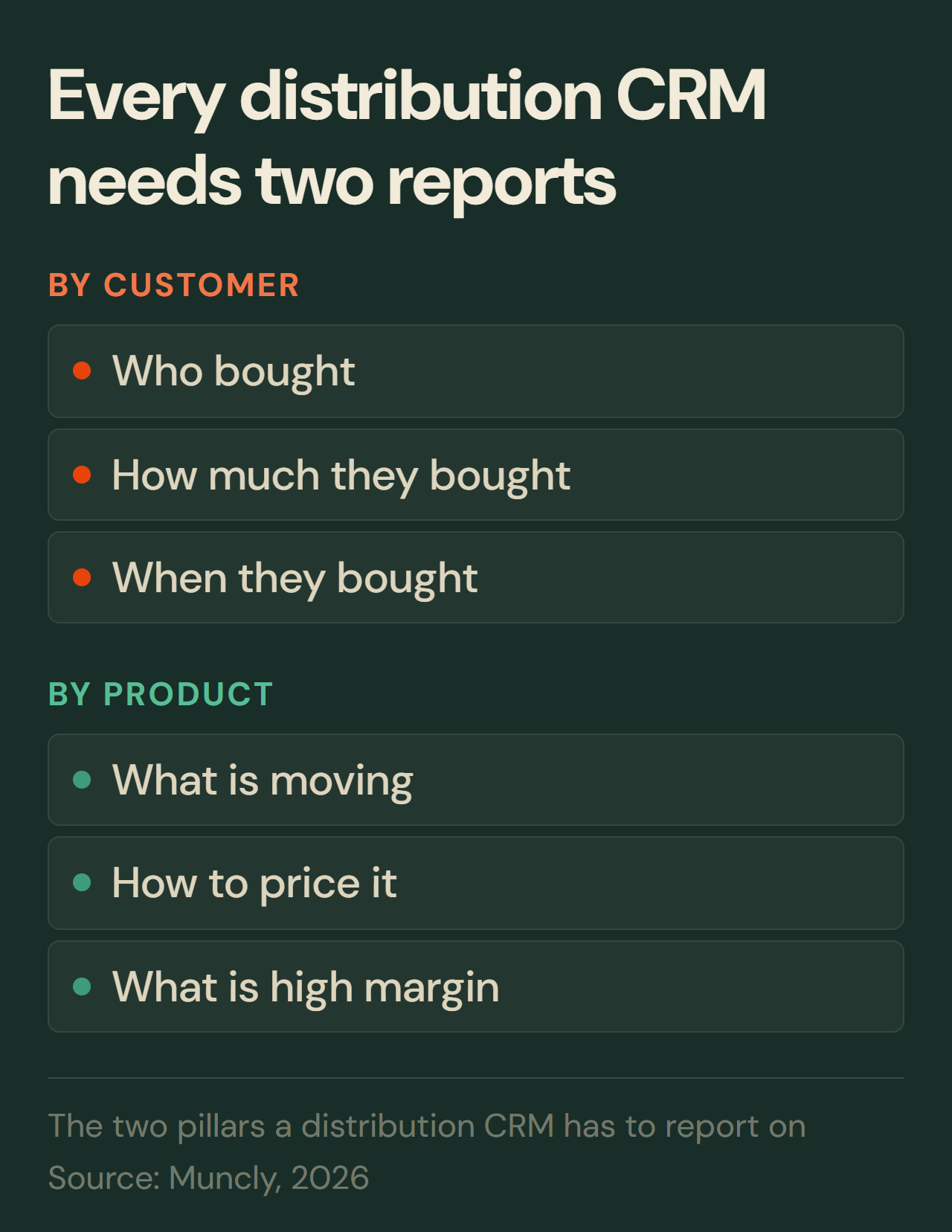
In distribution, everything revolves around the customer. In construction, by comparison, the business revolves around the project; in insurance, around the policy. For you, it’s the customer. And because of that, you end up with two kinds of reporting. The first is by customer: who bought, how much, and when. The second is by product: what’s moving, how to price it, what’s high-margin and what isn’t. Customer and product — those are the two pillars distribution stands on.
So in this article I’m going to cover both sides: building customer relationships (how to serve your customers, how to spend less doing it, and how to grow the average order), e-commerce and its role in modern distribution, and warehouse management.
Customer acquisition
Let’s start where sales should start: acquiring customers. From a CRM perspective, this is the simplest part of your business — meaning, from a software standpoint, very simple tooling is all you need. Here’s why.
Acquisition in distribution is pretty straightforward. Leads come to you from trade shows, cold calls, occasionally ads (advertising doesn’t work all that well in this industry), and search traffic. And if you’re the exclusive distributor for a brand, customers find you on their own. There’s simply no other supplier in the region.
From there, your job is to get the customer to their first purchase. You make contact, figure out what they need, and run KYC — check the paperwork, the company registration, the VAT number, whether there’s a conflict of interest, whether you’re even allowed to sell into that region. Then they place their first order, usually a minimum-volume one. For some businesses that’s three hundred euros; for others it’s two hundred thousand. It depends on your industry. For this entire journey, from lead to first purchase, a simple Kanban board is enough. That’s all the tooling you need at the acquisition stage.
But when a customer places their second order, they become a repeat customer. And that’s where the real problem shows up.
The real problem: retention
That problem is retention. The classic CRM playbook says: assign a rep, have them check in with customers now and then, “build the relationship.” But that rarely keeps anyone coming back. A phone call every few months isn’t a reason to reorder. It just doesn’t work that way.
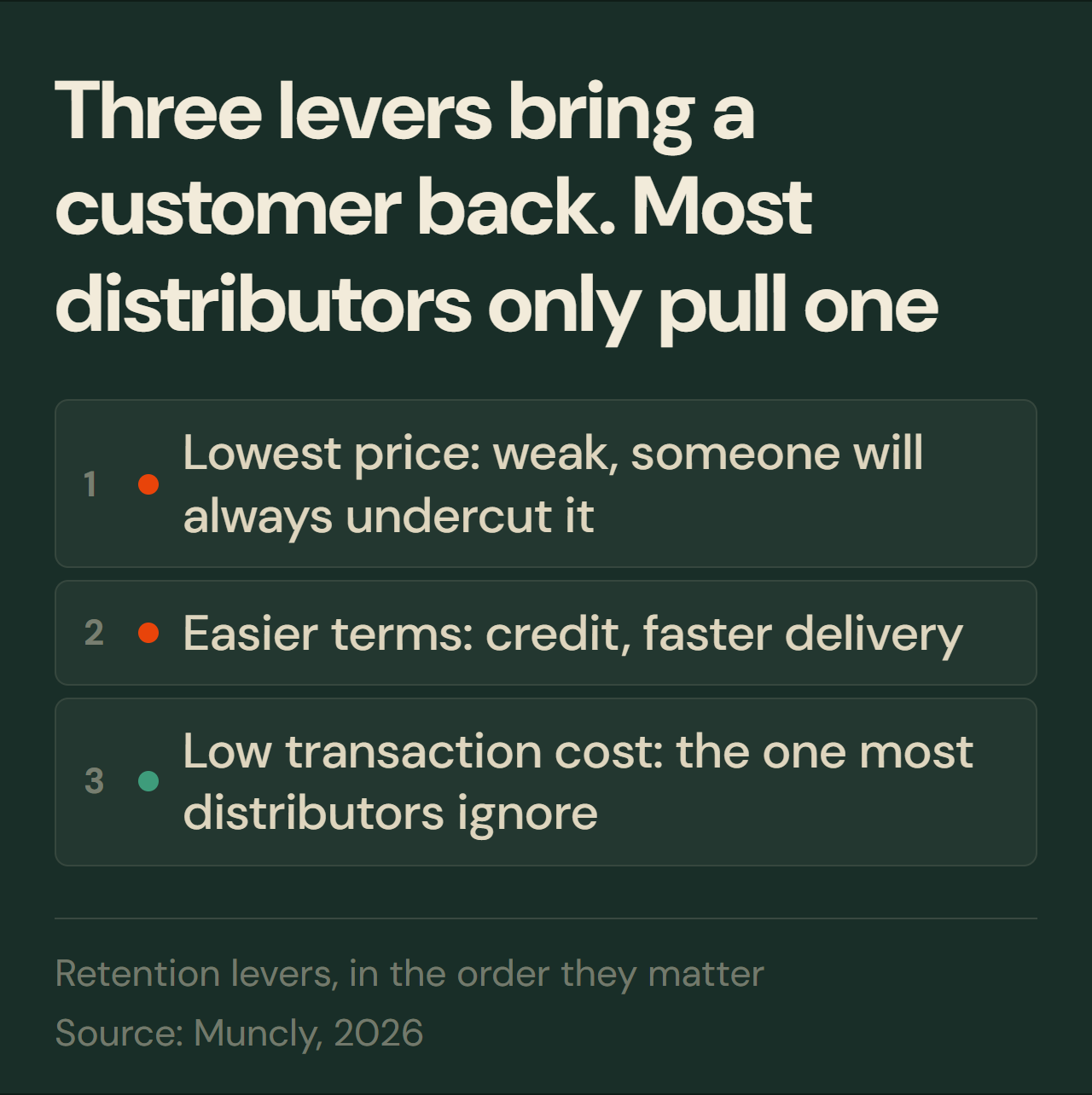
There are really only three levers that bring a customer back. Let’s walk through each.
The first one is offering the best price on the market. But that’s a weak lever, because someone will always be willing to undercut you.
The second one is being easier to work with. For example, offering better payment terms — instead of prepayment, net fifteen, net thirty, net sixty, net ninety, essentially extending credit to your customer — or fast delivery, where the product is always in stock because you know exactly which items to keep on hand and when.
The third one is lowering transaction costs. Simply put, it’s about making the buying process as easy as possible. This is the lever everyone ignores, so let’s dig into it.
Take this example. I recently needed a coffee machine for the office, so I called the company that services ours — the official distributor for the brand I wanted. Their website didn’t even list the machine. I called, they promised a quote, and then… nothing for two days. I called again — “yes, yes, sending it now.” Three days later, still nothing, so I gave up and bought the same machine elsewhere online — three hundred euros more, but delivered the next day.
Look at what happened. I was already their customer. I bought from them regularly, and they had my contact details and my full order history, exactly what any CRM gives you. And they still lost the order, simply because buying from them was too much of a hassle. That’s transaction cost in action: make it hard to buy, and the customer leaves.
Being incredibly convenient
So how do you get rid of that friction? It’s actually pretty simple. Look at the situation through your customer’s eyes. They want to place an order whenever it suits them: late in the evening, on a weekend, between two meetings, sometimes in the middle of the night. But your sales rep works nine to six. Somebody has to adjust, and it’s definitely not going to be the customer.
Which means you need to be available around the clock and the only thing that can give you that is e-commerce, essentially a website. But not all websites do the job. Anyone can slap together a catalog with no stock levels and no delivery estimates, and that won’t keep a single customer coming back.
What you need is a convenient website — one that shows how many units are in stock right now; when the product will arrive if it’s out of stock; and, if the exact date is unknown, how long this product usually takes to come in from this particular supplier, based on real statistics. And the statistics have to be real, not made up — which happens more often than you’d think.
No employee, no matter how experienced, can tell you the exact average lead time from a given supplier. Software that’s been tracking that data for years can.
And that, right there, is what actually makes you more attractive than your competitors — not a prettier website, not a friendlier sales rep, but the ability to give the customer data that makes their decision easy. When people see “this arrives on this date, in this quantity,” they feel a sense of control. And a person who feels in control makes decisions faster and with less hesitation.
Don’t just take my word for it. A Gartner study from before the e-commerce boom really took off found that inventory visibility alone can lift conversion by up to twenty-seven percent. Simply being honest about your stock levels is already a boost to sales. And B2B buyers behave exactly the same way regular consumers do. If I land on a website and can’t tell whether a product is in stock or when it will arrive, I simply won’t order. No sense of control, no order.
The turn
Now that we’ve looked at both acquisition and retention, let’s come back to the big question: what system does a distributor actually need? Look at what we’ve found. Acquiring new customers is easy. A Kanban board handles it. Keeping your regulars is hard, and that’s exactly where your focus should go. So if you’re a distributor deciding where to invest, build a great retention system and give your customers the right tools. Do that, and you can bring in two hundred new customers a day if you like. Your system will digest them.
The tech stack
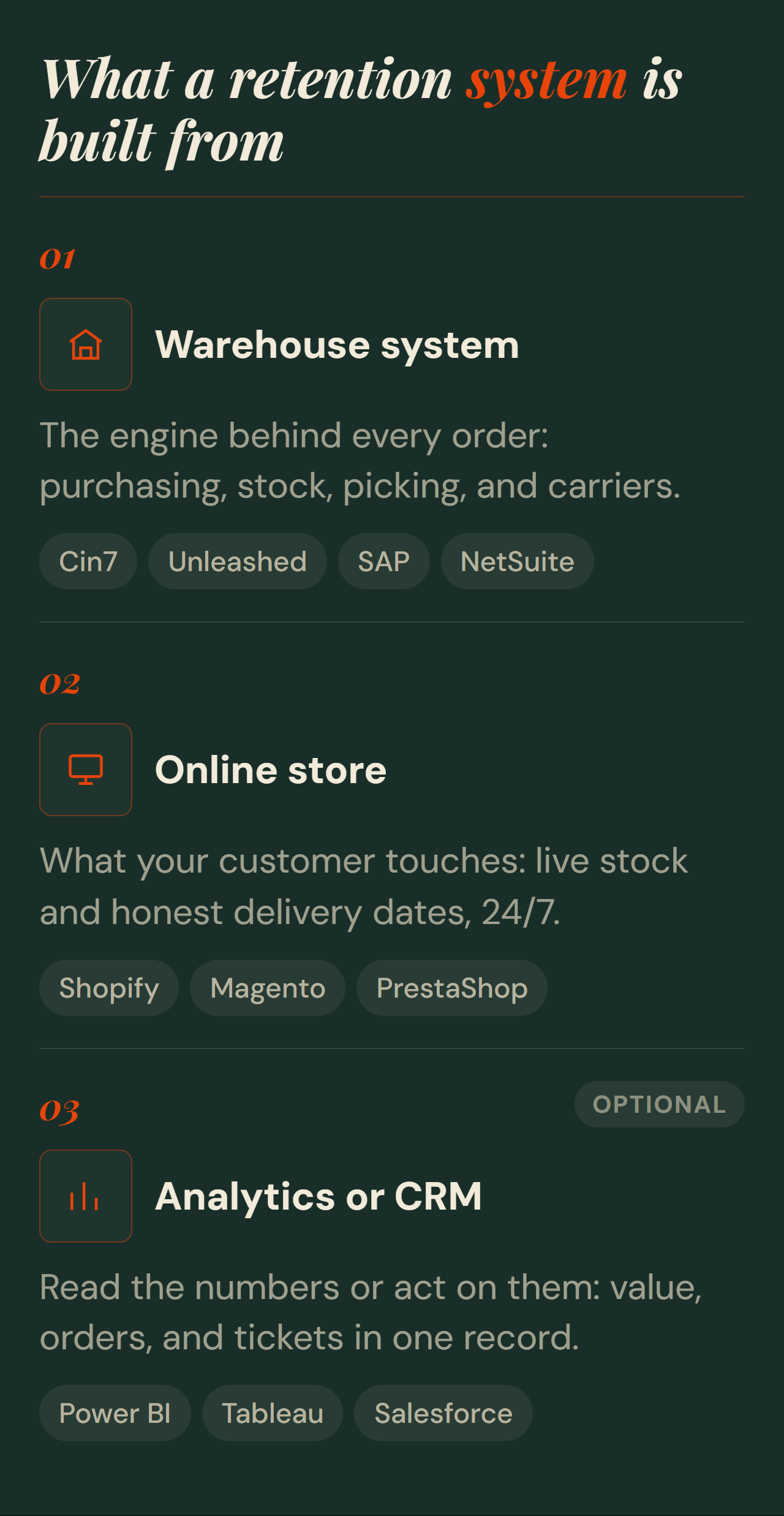
Now let’s break down what that retention system is actually built from. You’ll need a warehouse system, an online store, and — optionally — analytics on top. Let’s go through them one by one.
The first one is a warehouse system. For mid-sized businesses I recommend Cin7, a sophisticated corporate system, or Unleashed Software, a British product. Both are versatile enough to cover almost any warehouse-management scenario: purchasing; backorders (pre-orders for when the shelf is empty); consolidating orders from multiple customers into a single purchase order to a supplier; and allocation — when part of an incoming batch is already reserved for specific customers while the rest is still free, with that information flowing straight into your online store.
A good warehouse system does more than that, too. It knows about bins — the storage locations in your warehouse — it can build optimal picking routes, print shipping labels, and integrate directly with carriers like FedEx, DHL, or your local equivalent. It also needs to track payments and invoices, meaning it has to work with your accounting software, whether that’s Xero, QuickBooks, or FreshBooks — it doesn’t matter which one you run. The moment a payment comes in, the warehouse system sees it, and the order status updates right away.
If your business is large, you’re already at the ERP level — systems like SAP, Sage, NetSuite, or Dynamics 365.
One fair warning, though — actually implementing these systems is hard and here’s why. Vendors make their money on licenses and barely bother with support. Their technical specialists are usually strong programmers, but they don’t quite grasp that software doesn’t live in a vacuum. It lives inside a real business. Which means you’ll mostly be counting on yourself: find a good implementation partner, and be prepared to dig in personally, because nobody understands your business better than you do.
The second one is an online store. This is the part your customer actually sees. I usually recommend Shopify. It’s easy to customize and, on the whole, a solid product. But it has one serious drawback: the built-in customer portal is very limited. For example, if a customer’s order is split across several shipments — some items arrived, some on backorder — Shopify can’t natively consolidate that into a single delivery. The best it can do is two separate shipments under the same tracking number, which is clumsy. That’s why we always build a custom customer portal — a separate account area that pulls its data straight from the warehouse system.
Of course, there are alternatives. Take Magento, for example. It’s old and heavy, with a massive codebase, slow to work with, and it needs skilled developers to implement. Still, you can build almost anything on it if you’re willing to put in the work. Or take OpenCart, which is simpler overall, but its shipping features are weak, so you’ll end up building that part yourself. And then there’s PrestaShop, a French open-source platform, which is also worth considering.
Which raises a fair question: if open source is better, why do I still usually recommend Shopify? The answer is simple. We think not only about the moment of implementation, but about where the client will be five years after we finish the project. Open-source solutions tie you to a single developer or vendor. If they disappear, so does your support. With Shopify, there’s a company behind it, and you’re paying them a monthly subscription specifically to keep the site running. Five years from now, it’ll still be up, because that’s literally their job.
And the third one is customer analytics and this one’s optional. If you want to track lifetime value and metrics like that, you have two routes. The first is BI tools: Power BI, Looker, Tableau, or Salesforce’s CRM Analytics. Data flows in from all your sources and you simply read the dashboards. That tends to suit smaller companies without a heavy daily operational load.
The second route is a full-fledged CRM, something like Salesforce. There, you don’t just look at the data. You work with it. You open a customer’s record and see every order, every support ticket, every call, every contact, and you manage the account right from there, while your e-commerce portal feeds off the same system. That’s the option for companies with lots of customers and a small team. It’s how you spend less time and money serving each customer. There’s no universal recommendation here; it has to be judged case by case.
To sum up
So that’s really the whole picture: a warehouse management system, an e-commerce platform with a custom customer portal, and, if your business needs it, analytics or a full CRM.
If you run a distribution business and want help figuring out which of these solutions you actually need, book a free consultation with our team. We’ll assess your current processes, identify where friction is slowing your business down, and recommend the solutions that will deliver the greatest impact—so you can invest in the systems your business actually needs, not the ones everyone else is buying.
If you want the two page version of everything above, we put together a free cheat sheet that walks through the acquisition-versus-retention split and the tech stack in a single sitting. You will find the link in this article and in the sidebar.
And if you want a faster, more specific answer, come talk to us for a free CRM audit. We map how your company handles reordering today, then tell you plainly what to fix first and which systems fit. Book it here: https://munc.ly/distribution