
More than a decade of studies has tried to answer one question: which work can machines do? The answers are more precise, and stranger, than the headlines suggest.
Ask a roofer whether AI threatens their trade and you will probably get a laugh. Ask a translator and you may get a longer pause. Both reactions, it turns out, match the data almost exactly.
Since 2013, economists at Oxford, engineers at Microsoft and OpenAI, and researchers at the UN’s labour agency have measured, in increasing detail, which jobs artificial intelligence can reach. Their findings agree more than they disagree. And the most useful lesson is one few headlines mention: the biggest risk is not what AI can do today. It is what your business has written down, and what it has not.
The study that started it all
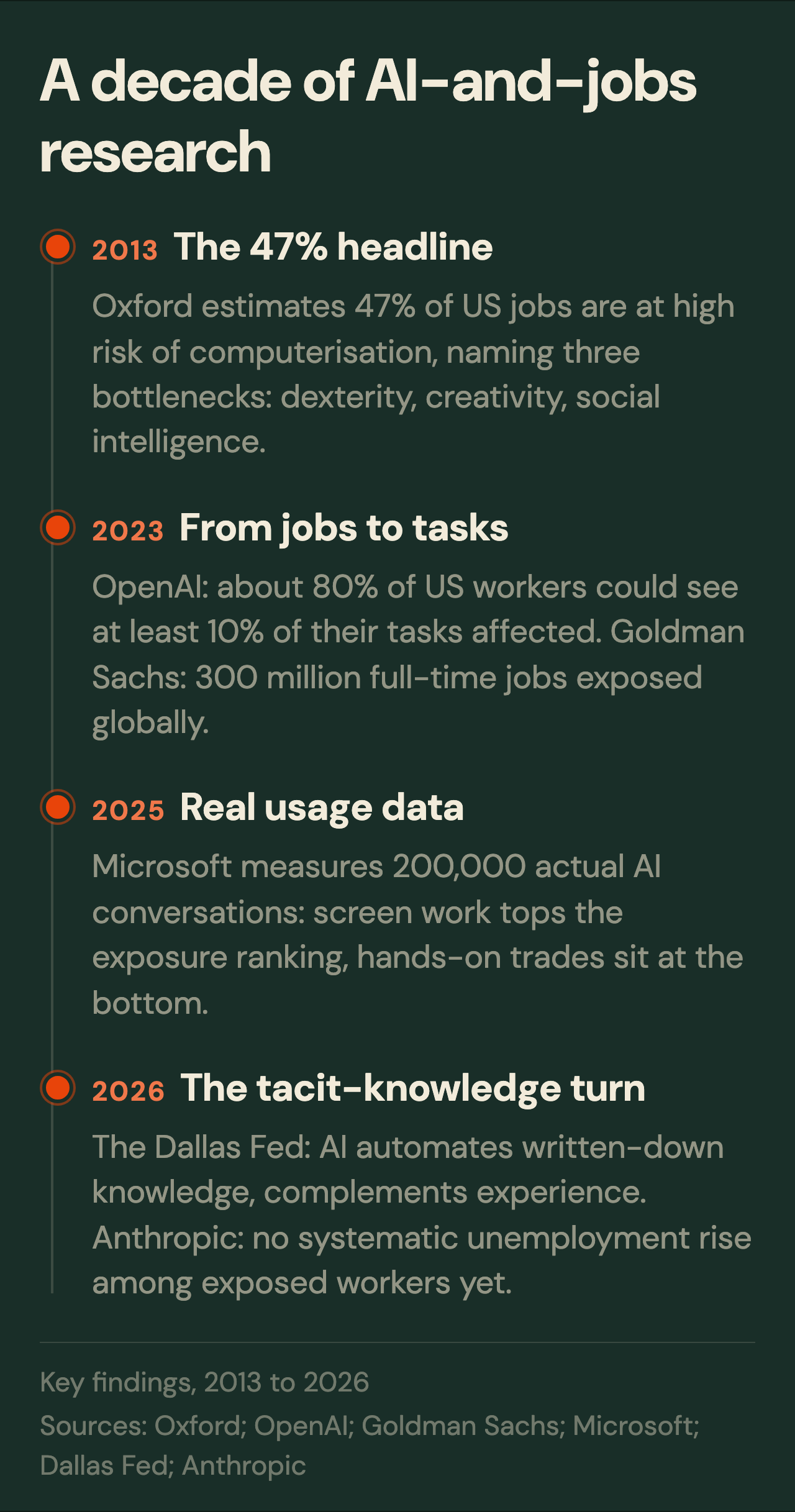
In 2013, two Oxford academics, Carl Benedikt Frey and Michael Osborne, published a paper with a number that travelled around the world: 47% of American jobs, they estimated, were at high risk of computerisation. The Future of Employment examined 702 occupations and scored each one against what they called bottlenecks: things machines could not do.
They found three. Machines struggled with fine physical work in messy, unpredictable places. They struggled with original, creative thinking. And they struggled with social intelligence, meaning persuasion, negotiation and caring for other people.
The paper inspired a wave of interactive tools, including a BBC calculator that let readers type in their job title and receive a risk score, and the long-running site Will Robots Take My Job?, which still ranks occupations today. The 47% figure was widely criticised as too dramatic, and later research moved from scoring whole jobs to scoring individual tasks. But the three bottlenecks held up remarkably well.
Then someone checked what AI is actually used for
Predictions are one thing. In 2025, Microsoft researchers did something different: they read the evidence. Their team analysed 200,000 real conversations between users and the Bing Copilot assistant, then mapped what people actually asked AI to do against the tasks that make up each occupation.
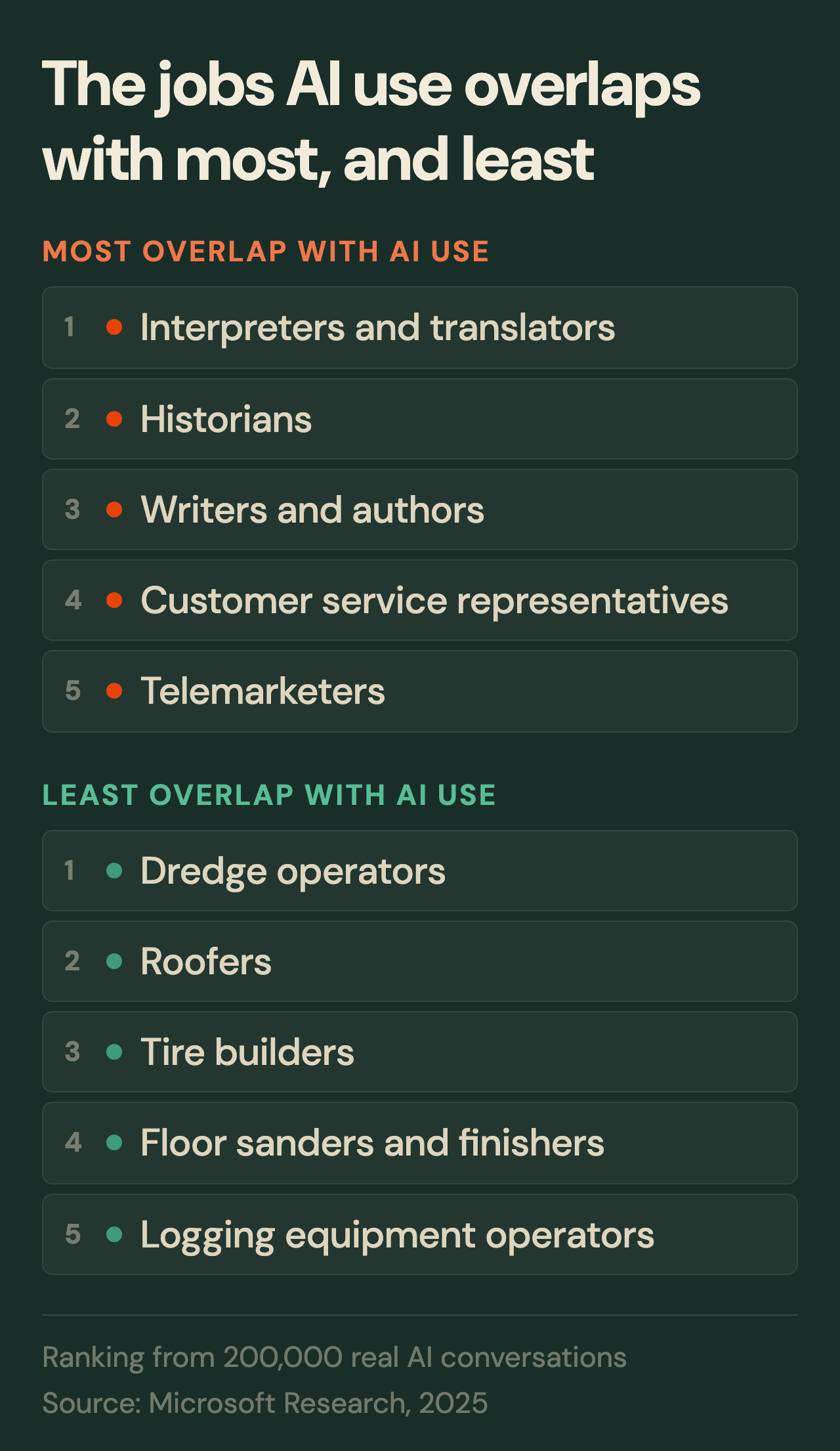
The results, summarised by GeekWire, read like two different worlds. The jobs with the highest overlap were interpreters and translators, historians, writers, customer service representatives and telemarketers. Knowledge work, in other words, done through a screen.
At the bottom of the list: roofers, dredge operators, tire builders, floor sanders and machine operators. Work done with hands, on site, in the physical world. The pattern Frey and Osborne predicted from theory in 2013 showed up in the usage logs of 2025 almost unchanged.
OpenAI’s own researchers reached a similar conclusion from another direction. Their study, titled GPTs are GPTs, estimated that about 80% of American workers could see at least one in ten of their tasks affected by large language models. But the word they chose was careful: affected. Which brings us to the most misunderstood word in this whole debate.
Exposed does not mean replaced
Almost every study in this field measures something called exposure: how much of a job’s work AI could theoretically touch. It is routinely reported as jobs that will disappear. The researchers themselves keep saying otherwise.
The International Labour Organization, which built a global index of occupational exposure, found that worldwide, far more jobs are likely to be transformed by generative AI than eliminated by it. Clerical and administrative work carries the highest automation potential; most other occupations sit in the augmentation category, where AI helps a human rather than replacing one.
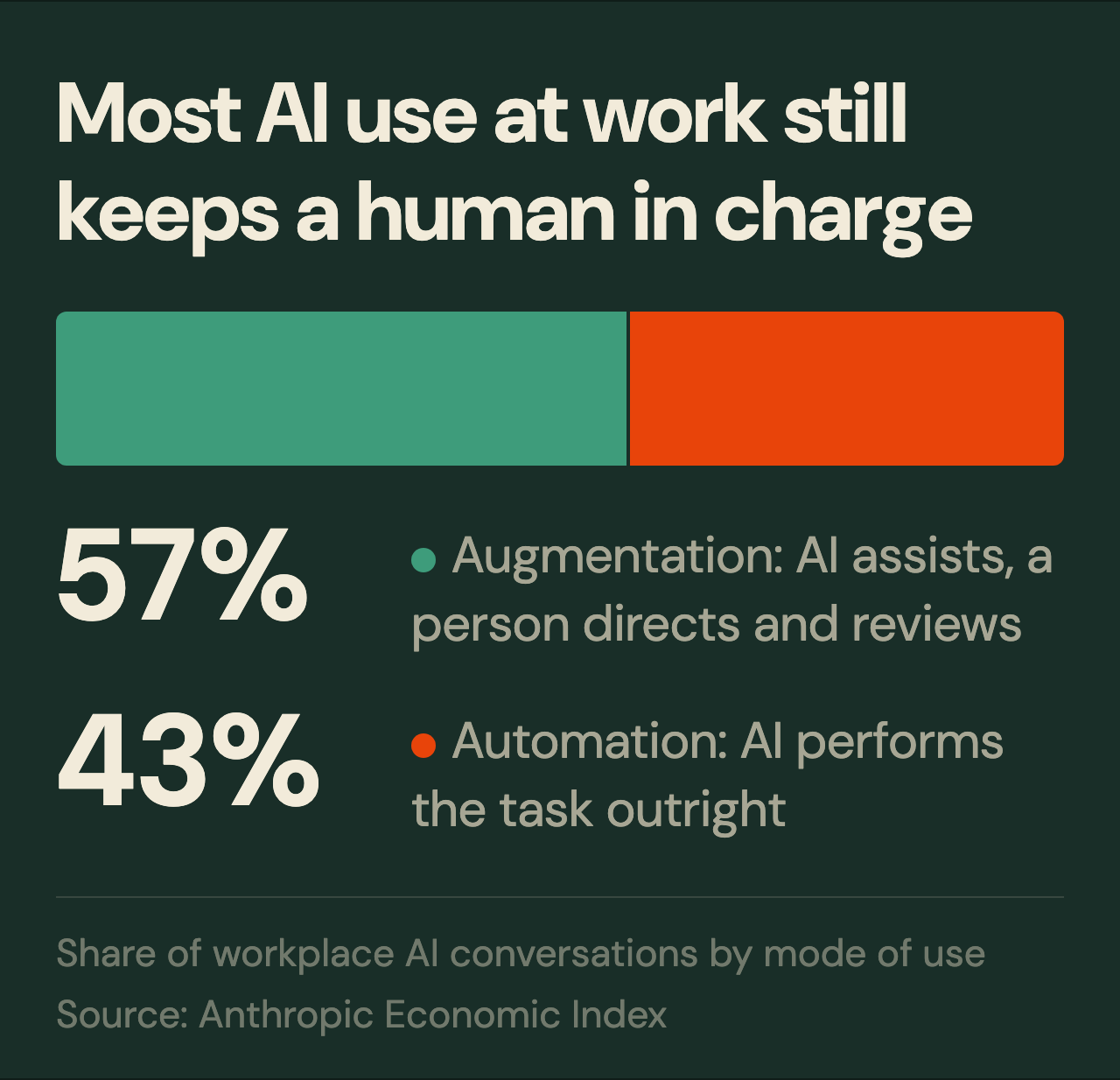
Anthropic, the company behind the Claude assistant, publishes an Economic Index based on millions of real conversations. Its finding: 57% of AI use at work augments a person who stays in charge, while 43% automates a task outright. Its follow-up research on labour markets adds two sobering notes. Actual AI usage remains a fraction of what is technically possible. And so far, the researchers found no systematic rise in unemployment among the most exposed workers, though hiring of younger workers in exposed fields may be slowing.
Independent economists agree that the story is early. Stanford’s Digital Economy Lab and Yale’s Budget Lab have both examined the employment data and found little evidence, yet, of AI-driven job losses at scale. That does not mean nothing is happening. Goldman Sachs estimates that generative AI could eventually expose the equivalent of 300 million full-time jobs worldwide to automation. It means the change is arriving as a slow rewiring of tasks, one workflow at a time, rather than as a wave of layoffs.
The twist: it is about what is written down
Buried in a research note from the Federal Reserve Bank of Dallas is the sharpest single sentence in this literature. AI, the economists write, will automate jobs that require codifiable, textbook knowledge, and complement jobs that demand experiential, tacit knowledge.
Codifiable knowledge is anything that can be written down as rules, steps or examples. Tacit knowledge is the rest: the plumber who knows which pipe will fail by the sound it makes, the consultant who senses a board room turning, the salesperson a customer trusts on instinct.
That sounds like good news for anyone whose value lives in experience. It is, with one large caveat. Companies have noticed where the tacit knowledge is, and they are coming for it. The Economist reports that firms are now using AI to capture how their experienced people work, through data analysis, video monitoring and expert evaluation systems, precisely so that knowledge stops being tacit.
The competitive logic is uncomfortable but simple. A rival does not need AI to match your best person. It needs AI to deliver a good-enough copy of what your best person knows, at a lower price. Undocumented expertise does not get replaced. It gets undercut.
This cuts both ways for any business owner. Knowledge that lives only in one employee’s head is protected from AI, and completely unprotected from that employee resigning. Knowledge that is written down survives departures, and becomes something a machine, yours or a competitor’s, can learn. The question is who does the writing down first.
Why we all assume it is someone else’s problem
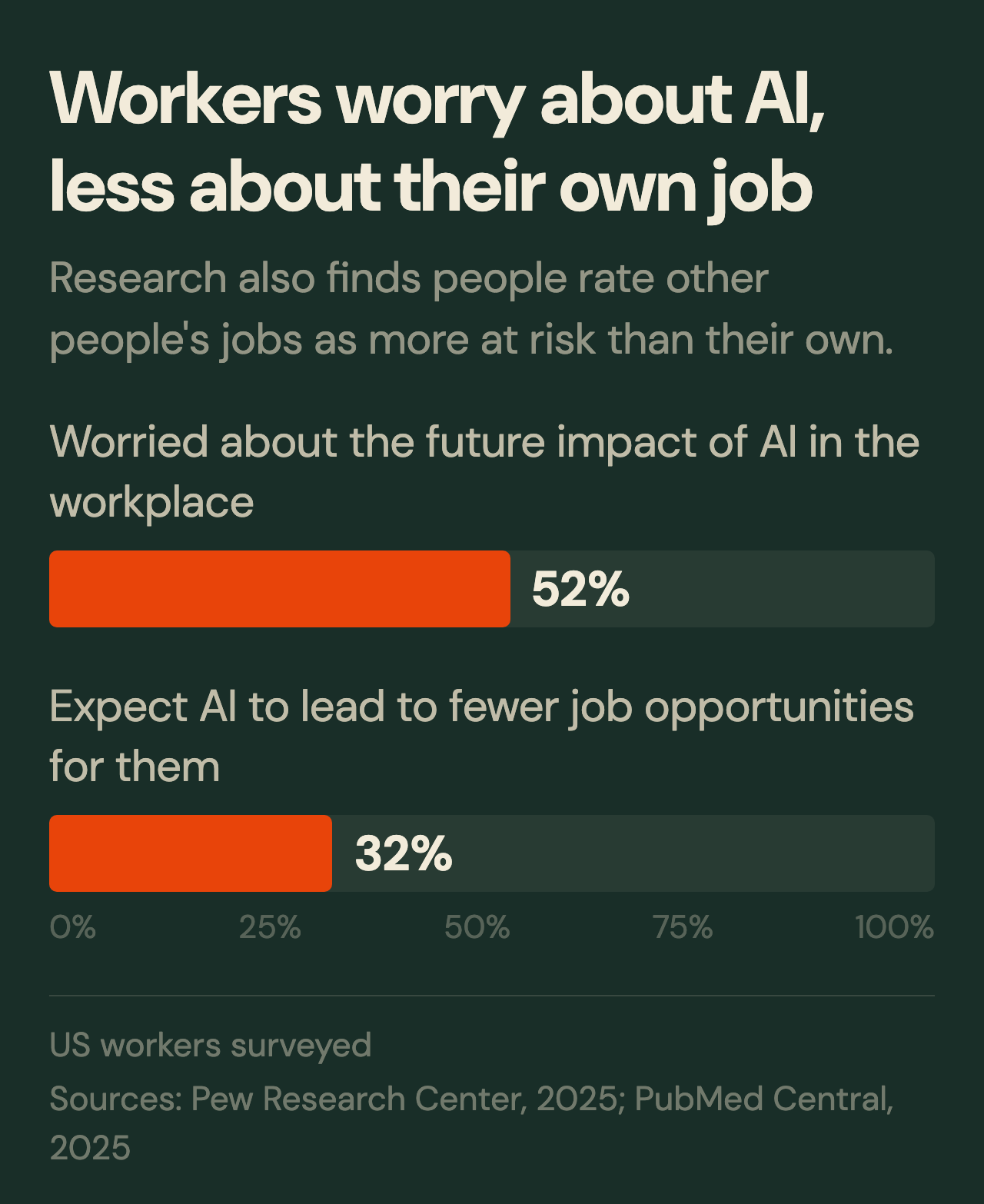
Public anxiety about AI is real. Pew Research found that 52% of American workers are worried about AI’s future role in the workplace, and 32% expect fewer opportunities because of it.
But worry has a blind spot. A peer-reviewed study of worker attitudes documented what its authors call an invulnerability bias: people consistently believe AI will affect other people’s jobs more than their own. We are, it seems, all reading the same headlines and excluding ourselves from them. The consultant assumes it is about drivers. The driver assumes it is about consultants.
The research suggests a more even-handed reality. In consulting, for example, Harvard Business Review reports that AI is already absorbing the research, modelling and analysis that junior staff used to do, reshaping how firms are structured. The advice itself still belongs to humans. The layer of work around the advice is moving fast.
So what should you actually do?
Read together, the studies point to three practical answers rather than one dramatic one.
First, know where your work sits. Physical, unpredictable, on-site work remains the hardest for machines to reach. Screen-based production, such as writing, translating, processing and routine analysis, is where AI is landing first. Advisory work sits in between: the judgment holds, while the research and paperwork around it are increasingly automated.
Second, treat repetition as a signal. Across every study, the tasks that go first are the ones that repeat: the same questions answered, the same documents drafted, the same reports rebuilt each month. If part of your week is a copy of last week, that part is exposed, whatever industry you are in.
Third, and least obvious: write things down before someone else does. The Dallas Fed’s line between textbook knowledge and experience moves every time someone codifies a piece of expertise. Businesses that document their own judgment, their decision rules, their customer knowledge, their improvised fixes, get to keep the benefit of that knowledge when staff leave and to automate on their own terms. Businesses that leave it in people’s heads are betting that nobody else will ever write it down.
The honest summary of a decade of research is this: AI is unlikely to take your job outright this year. It is very likely to take specific pieces of it, starting with the pieces that were already routine. The owners and workers who come out ahead will be the ones who saw which pieces those were before their competitors did.
Curious where your own business stands? Muncly built a free 60-second AI exposure quiz on the research covered in this article.